July 2023

California Department of Housing and Community Development Awards Prohousing Designation to Five New Jurisdictions
Off
Sacramento, CA
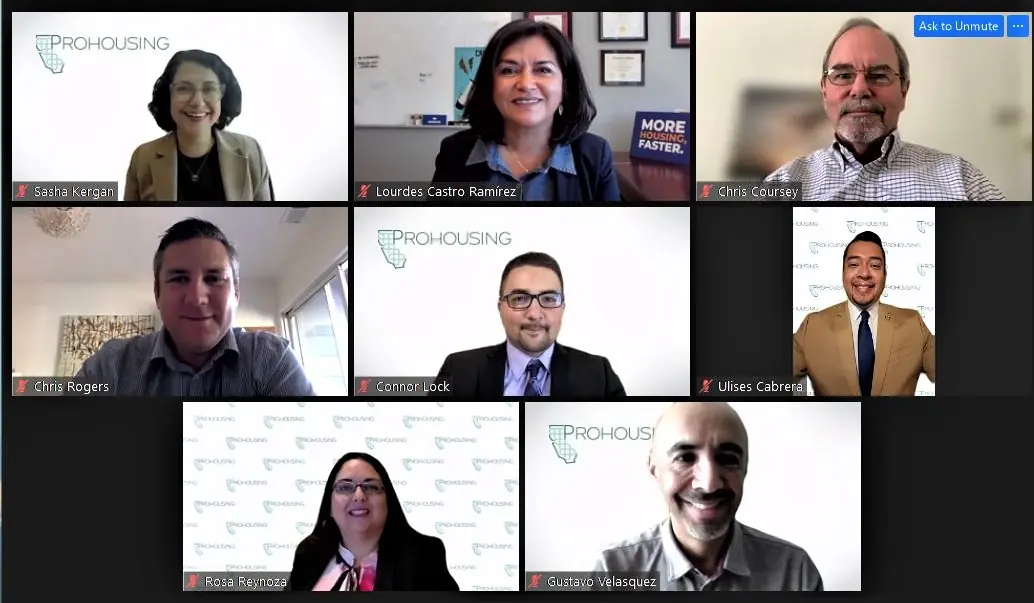
BCSH, HCD and prohousing jurisdictions.

Governor Gavin Newsom today announced that Long Beach, Moreno Valley, Santa Rosa, Sonoma County, and the Town of Windsor have been designated as Prohousing communities. Through this designation, these jurisdictions are now eligible for funding incentives and additional resources through a state grant program designed to speed housing production. To date, a total of 27 California communities are now designated as Prohousing.

Why it matters: To meet the needs of Californians and address our state’s housing crisis, each local jurisdiction must take accountability to build their share of housing. To tackle this challenge, decades in the making, it will take a concerted effort between state and local leaders in partnership with nonprofits, advocates, and developers to enact Prohousing policies.

What Governor Newsom said: “Every city and county across California needs to work together to tackle the state’s housing crisis. Rather than evade their duties, these Prohousing communities are committed to rolling up their sleeves and building more housing, faster. By working together, we are putting the needs of Californians first and seeing to it that housing gets built faster throughout the state.”

The Prohousing Designation Program was established by the 2019-20 Budget Act, as part of a package of supports, incentives, and accountability measures to help California meet its goal of building 2.5 million homes by 2030, with at least one million of those homes affordable to people at lower income levels. The Prohousing Designation Program encourages jurisdictions to pass and implement policies that accelerate housing production, promote favorable zoning and land use, reduce construction and development costs, and provide financial subsidies.

Communities that earn the Prohousing Designation receive incentives such as additional points or other preferences in the scoring of competitive funding programs administered by the Department of Housing and Community Development (HCD), giving them an advantage over other jurisdictions.

Jurisdictions that earn the coveted Prohousing Designation have demonstrated a commitment to enacting Prohousing Policies to accelerate housing production and preserve affordable housing stock, and they have shown themselves to be partners with the state in combatting the housing crisis. These partners recognize that increasing the availability of housing statewide is critical to bettering quality of life for all Californians, and to ending homelessness.

“Expanding housing opportunities is critical for the social and economic well-being of working Californians, families with children, older adults, and people exiting homelessness,” said Business, Consumer Services and Housing Agency Secretary Lourdes Castro Ramírez. “Under Governor Newsom’s leadership, we have provided more tools and incentives than ever before for communities to design policies and programs to build more housing in the right places. Congratulations to the five jurisdictions announced today. They join 22 others that have done the hard work to remove barriers to housing so that homes can be created that are accessible to all Californians.”

“Creative efforts to enhance state and local partnerships are essential to meeting ambitious and necessary state housing goals,” said HCD Director Gustavo Velasquez. “We recognize today local governments that are breaking down barriers to affordable housing – and reward those good actors with incentives to enhance the work they are already doing.”

Listing of five new Prohousing designations, showing each location on a map of California.

City of Long Beach
The city of Long Beach has demonstrated a sustained commitment to improving access and reducing barriers to new housing. First, as part of a phased rezoning effort, the City’s transitional Title 22 zoning code introduces ten mixed-use districts, introduces objective design and development standards, and eliminates density limits within designated areas. The city will soon fully transition to Title 22 zoning, ultimately applying its provisions to all areas outside the Coastal Zone while reducing parking requirements and adding two more multi-family zoning districts. Additionally, 100% affordable projects are now approved ministerially with no public hearing requirement, and the city has established covenant requirements for inclusionary or no-net-loss units as affordable in perpetuity. The city legalized existing unpermitted dwelling units in 2021 through an amnesty program. Numerous actions have been taken to streamline ADU/JADU approvals and the city has launched a pre-approved ADU program with contact information for design professionals provided.

City of Moreno Valley
The city of Moreno Valley has demonstrated a commitment to lowering costs and increasing construction of new and affordable housing. The city’s new 2040 General Plan Update has created new mixed-use zones that increase density and expand housing opportunities to meet its 6th Cycle regional housing needs allocation (RHNA) requirements. Additionally, the city now has a “Digital Plan Room” that provides a convenient way for customers to remotely, electronically submit planning documents through a standardized and streamlined process. The city has a new expedited plan review process by which it conducts standard expedited entitlement reviews, with first reviews completed within 18 business days. Second reviews are completed within 13 business days, and subsequent reviews are completed within seven business days. This process will help reduce development costs. Finally, the Moreno Valley Housing Authority was created in 2023 to address the city’s need for safe and sanitary affordable housing opportunities for its residents. The Housing Authority has established a special revenue fund restricted to affordable housing.

City of Santa Rosa
The City of Santa Rosa has enacted multiple changes to increase production and to improve access to affordable housing. First, the city’s density bonus program offers supplemental bonuses in excess of the state density bonus. Within the city’s Downtown Station Area Specific Plan and North Santa Rosa Station Area Specific Plan boundaries, residential projects may qualify for a supplemental density bonus up to 100% above the General Plan residential density limit based on land use designations, proximity to a major transit stop or school facility, or location in a General Plan Housing Opportunity Site. Second, the 6th Cycle Housing Element accounts for 150% of the City’s total RHNA. With the units under construction from June 30, 2022, and later (397 units), the 6th Cycle Housing Element accounts for 163% of the city’s remaining total RHNA. Further, the Santa Rosa Zoning Code now includes reduced parking requirements in two of the City’s Priority Development Areas and for the areas around the Sonoma-Marin Area Rail Transit stations, as well as allowances for shared and unbundled parking. Finally, the city has adopted a Greenway Plan that will preserve open space and provide housing in an underutilized area previously designated for expansion of Highway 12. This will result in new development potential of up to 47.2 acres of parks and recreational uses/open space and 244 multi-family housing units.

County of Sonoma
The County of Sonoma has enacted a wide variety of policies that will help increase housing supply and lower construction costs. For example, the County’s Cottage Housing ordinance allows up to three detached units in a single-family residential zone by right. Cottage housing developments are a type of infill development intended to provide small-scale, clustered housing units comparable in scale and intensity to single-family residential use. In September 2022, the County implemented a Digital Plan Room. This web-based plan review application allows customers to electronically submit plans and documents and provides staff the ability to collaboratively review plans online and identify issues or conditions required for approval. Plan reviewers can compare submitted revisions using tools such as overlay and side by side. This greatly improves communications between planning staff and customers while allowing for the timely management of issues and execution of permits. Finally, the County created a local housing trust fund – the County Fund for Housing (CFH) -- in 2003 with a matching grant from HCD. The CFH is intended to develop, preserve, and accelerate the pace of development of below market-rate housing for low-, very low-, and extremely low-income households. Ongoing funding comes from inclusionary and workforce housing in-lieu fees, a portion of the County’s transient occupancy tax revenues, and periodic additional contributions from the County General Fund. To date, the fund has loaned $41.85 million dollars.

Town of Windsor
The Town of Windsor has enacted multiple changes to increase housing supply and lower development barriers. For example, the Town is zoning for 217% of its total 6th Cycle RHNA, far beyond what is required. To help address the needs of families, the Town offers an additional density bonus or other economic incentives for residential projects that include a childcare center. Further, the Town has established a streamlined ministerial approval process for qualifying applications received under SB 35 and SB 330; Multifamily Objective Design Standards have been adopted to assist with SB35 and SB330 applications; and a revised process is now in place for both types of applications. Processing times are anticipated to improve with subsequent applications. Finally, the Town’s optional concept review process is a low-cost way to get feedback early in the building design process and streamline the formal development application stages, reducing development costs by identifying potential hurdles early without excessive design and engineering work. To reduce applicant barriers, the Town now has options for formal administrative review only, as well as a public workshop with the Planning Commission.

  • Prohousing
  • Press Release
  • July 14, 2023
    HCD Press Office
    Off
    Article

    Business, Consumer Services and Housing Agency and HCD Today Announced $21 Million to Advance Construction of Climate-Smart and Affordable Housing on State-Owned Lands

    Off
    Sacramento, CA
    Photo of Sonrisa Apartments. Business, Consumer Services and Housing Agency Secretary Lourdes M. Castro Ramírez with resident Samiya.

    Why it matters: Governor Gavin Newsom recognized the potential for underutilized state properties to play a key role in increasing housing availability in California. The effects of his executive order to explore this path are coming to fruition, with state property now housing low-income Californians and thousands more new homes in the works!

    This year marked a milestone for Governor Gavin Newsom’s push to develop much-needed affordable housing on underutilized state land, as the first project awarded under an order to reimagine state excess sites for housing welcomed its first residents a year ahead of schedule.

    In 2019, Governor Gavin Newsom signed Executive Order N-06-19 to address the state’s acute affordable housing crisis by identifying state lands for the potential development of affordable housing on underutilized infill sites. The order set a goal of expediting selected projects and requiring a collaborative government approach between the Department of General Services (DGS) and the Department of Housing and Community Development (HCD).

    Since then, planning, funding, and construction of 5,500 new homes have been fast-tracked, and will create homes for tens of thousands of people over the lifetime of these communities. These homes will provide stability for working families and individuals and create jobs in communities around the state.

    “California continues demonstrating the significant potential of repurposing public land for public good. We are unlocking state-owned lands and transforming them to housing—sustainable and affordable housing for hard-working Californians, older adults, and youth,” said Secretary Lourdes Castro Ramírez at the Business, Consumer Services, and Housing Agency. “These new homes are being built to last and in walkable, transit-adjacent and job rich neighborhoods to further our climate goals and improve the quality of life in communities.”

    Part of the implementation of the Executive Order includes the Excess Sites Local Government Matching Grants Program (LGMG), an innovative and collaborative funding model administered by the HCD where the state, local governments, and selected developers work in partnership to build affordable housing on underutilized state-owned property. To date, the LGMG Program has provided nearly $60 million in grants to match more than $46.1 million that local governments are putting forward, filling gaps that slow down development of projects that align with state housing, climate, transit, and equity goals.

    “The progress on Governor Newsom’s executive order showcases California’s commitment to addressing a critical housing shortage,” said Government Operations Agency Secretary Amy Tong. “We firmly believe this will have a profound impact on residents and businesses in downtown Sacramento.”

    Today’s LGMG awards include:

    • Mutual Housing in Sacramento received $10,000,000 for the development of a 242-unit affordable housing project in Sacramento. This project brought in more than $12,000,000 in local funding and will provide housing affordable to households making between 30% of Area Median Income (AMI) and 70% AMI.
    • Visionary Homebuilders of California, Inc., also has received a Round 2 LGMG grant of $6 million to jumpstart construction of a 94-unit affordable development in Stockton.
    • Related Companies of California, LLC, received $5 million to begin construction of the third phase of Sugar Pine Village in South Lake Tahoe, bringing local affordable and environmentally sustainable housing opportunities to help the workforce avoid long commutes.

    "Since the inception of this housing program, DGS has been relentless in not only transforming state properties into affordable housing, but also in improving how we do so,” said DGS Director Ana M. Lasso. “We are particularly pleased to welcome creative partnerships with developers and to see those efforts bear fruit in such a diverse array of dwellings that will provide much needed housing to Californians."

    “The Governor’s Executive Order to identify and make use of state-owned, excess infill sites has allowed us to focus efforts on building affordable housing in places accessible to jobs and transit, creating a win-win-win for residents, the environment, and communities,” said HCD Director Gustavo Velasquez. “HCD's Excess Sites Local Government Matching Grant Program has allowed us to foster a proactive partnership with local jurisdictions to expedite housing development on state land, filling funding gaps that can delay or derail development and leveraging local investments for maximum community benefit.”

    Excess Sites Administered Jointly by HCD and DGS Brings Innovative Thinking and Local Investments to Build More Housing Faster

    Here are some highlights of what the Excess Sites executive order has done so far:

    • At 248 homes, Sugar Pine Village is the largest affordable multifamily development in the history of South Lake Tahoe. It exceeds the city’s planning goal for low-income homes and is being built with innovative modular construction that reduces construction waste and greenhouse gas emissions. The developer is partnering with the city and transit providers to increase bus connections throughout the region. This project took advantage of streamlining provisions in Senate Bill (SB) 35 and was fully permitted in just six months. The all-electric community with public service buildings powered by a microgrid is expected to serve as a resiliency center during inclement weather.
    • Pacific Crest Commons in Truckee will also use modular construction, as its abbreviated construction schedule is important in an area with severe and unpredictable weather. The City of Truckee was awarded an SB 2 planning grant to plan for mixed-use and pedestrian-oriented development in the high-resource neighborhood surrounding the 55-unit community.
    • Oak Hill Apartments, which features 250 homes in unincorporated Marin County, is the largest affordable multifamily development in Marin County in at least 50 years. The project is close to the SMART rail service that connects across the Bay Area, as well as bicycle and pedestrian trails, helping residents decrease their housing and transportation costs.
    • Built in the 1950s, the decommissioned Montebello Armory adjacent to Montebello City Park will be adaptively reused and expanded with factory-built homes, creating 57 studio to three-bedroom homes for people exiting homelessness and low-income families. The property will feature beautiful common areas including a central courtyard and landscaped rooftop deck, as well as office space for supportive services.
    • In San Francisco, the review and approval of plans for 262 homes for low-income residents were completed in under a year, significantly faster than the average housing project in the City and County is approved outside of the Excess Sites program. These homes will offer much needed affordability in an amenity and transit rich location.
    • More than 1,000 mixed-income homes are in the works for state Excess Sites in the City of San Diego. The developer intends to use non-traditional funding sources to shorten the project timeline and preserve critical funding from more traditional sources for other affordable housing projects across the state. These sites are in downtown, where homes will be close to jobs, services, and transportation options that will deliver climate and affordability benefits for generations to come.
    • In anticipation of HCD and DGS awarding an Excess Site there, the City of Riverside used an SB 2 planning grant to rezone a former CalFIRE property to permit dense, climate-smart infill development. This allowed the developer to accelerate environmental review, design, and approval of Mulberry Gardens, expediting delivery of 209 homes for low-income seniors and families.
    • The City of Sacramento authorized the transfer of land to HCD to expand a project already in development on a state site. The transfer will add an additional 20 homes for low-income families and a childcare center, for a total of 124 affordable homes across the surplus city property and an excess state armory. The city also gave $3,700,000 to the project, which is located on an infill site directly adjacent to a SacRT light rail station that will connect residents to jobs and services without the need for driving.

    For more information or to reach out for technical assistance visit Public Lands for Affordable Housing Development.

  • Excess Sites
  • Press Release
  • July 13, 2023
    $21 million awarded in matching grants supports 369 new homes as part of the 5,500 new homes in the works on state-owned excess sites
    HCD Press Office
    Off
    Article

    Governor Gavin Newsom Announces $159.9 Million Investment to Prevent 638 Homes from Losing Affordability Restrictions

    Off
    Girl on scooter

    Why it matters: In the Statewide Housing Plan we are guided by three principles to protect our most vulnerable residents, produce more housing faster, and preserve existing housing. Today, our commitment to preservation is supported through this historic investment of $159.9 million.

    What the Governor said: “As California faces a critical housing shortage, it is vital that we use every tool in our toolbox to build more housing faster and preserve affordability for individuals and families struggling with the high cost of rent. Every Californian deserves a place to call home, and we are aggressively working to secure more affordable housing throughout the state.”  

    In the ongoing effort to preserve affordable homes for lower-income Californians priced out of the rental market, Governor Newsom today announced $159.9 million in awards from the new Portfolio Reinvestment Program (PRP) administered by the California Department of Housing and Community Development (HCD). These awards keep an additional 638 homes in the pool of available affordable homes for up to 55 years.

    Map of California highlighting counties supported by Portfolio Reinvestment program. Text reads: 159.9 million in portfolio reinvestment program awards will keep 638 homes restricted as affordable for up to 55 years. Sonoma county 6 homes; Sacramento county 90 homes; San Joaquin county 24 homes; San Francisco County 172 homes; Alameda County 45 homes; Santa Cruz County 76 homes; Santa Clara County 21 homes; Kern County 16 homes; Los Angeles County 188 homes.

    Since its launch in 2022, the PRP has awarded nearly $315.3 million to preserve 1,364 affordable homes, assuring housing for nearly 27,000 people over the life of the developments’ affordability compacts. That’s over 1,300 homes that would have been lost to market rate rental or redevelopment.

    Preserving existing affordable homes is part of the multi-pronged strategy laid out in the California’ Statewide Housing Plan, which calls for 2.5 million new homes by 2030, with at least one million of those homes being affordable to Californians at lower income levels.

    The PRP preserves existing affordable housing projects funded by the HCD by extending and restructuring affordability agreements; extending loan maturity dates; providing new low-interest, long-term loans for rehabilitation; and providing forgivable loans to capitalize short-term operating subsidies.

    “As we work to expand the construction of new housing, it is critical that we also preserve, invest in, and maintain existing affordable housing in communities – it prevents displacement, is cost efficient, and improves neighborhoods,” said Business, Consumer Services, and Housing Secretary Lourdes Castro Ramirez. “These awards announced today by Governor Newsom will allow affordable housing community developers to improve the quality of living and extend the life of these buildings for many more years by making critical repairs such as fire and life safety improvements to common areas and new roof installation.”

    "Keeping safe, quality, affordable homes from reverting to market rate is a key component of any strategy to address the crisis of homelessness our state is facing,” said HCD Director Gustavo Velasquez. “These strategic reinvestments – that ensure HCD-funded properties remain livable and affordable for the foreseeable future – will offer tens of thousands of Californians the housing stability and supportive services they need to be successful in a life lived off the street.”

    HCD offered $332.5 million over the counter to affordable housing developers in the first round and received 34 applications totaling more than $350 million. Approximately $17 million remaining from the first offering of PRP funds will be added to the second round of $100 million funding approved in the recent budget for approximately $117 million. The notice of funding availability is anticipated in early fall of this year.

    The awards announced today include the following:

    • Mission Housing Development Corporation received $12,950,076 to preserve 49 units at Dunleavy Plaza in the County of San Francisco. Dunleavy Plaza was built in 1985 and is located in a densely populated area of San Francisco’s Mission District. PRP funds will be used to address critical repairs such as replacing the fire alarm and sprinkler head system, replacing insulation to increase energy efficiency, and roof replacement. The funds will also be used for remediation of water damage.
    • Abode Communities received $26,248,920 to preserve 144 units at Centennial Place in the County of Los Angeles. Centennial Place was built in 1910, originally serving as a YMCA. It now houses people who are formerly homeless or at risk for homelessness with very low incomes. The rehabilitation of Centennial Place will consist of elevator refurbishment, repairs to the exterior and common areas, a new roof, and fire alarm replacement.
    • Eden Housing, Inc., received $12,075,450 to preserve 45 units at Sparks Way Commons in the County of Alameda, built in 1985. They also received $5,719,492 to preserve 21 units at Hope Villa Esperanza, which was built in 1999 in the County of Santa Clara. A third award of $19,421,950 will preserve 76 units at the Vista Verde Apartments in Santa Cruz County. All three projects serve low-income households and will use these rehab funds to improve living conditions for tenants. The projects will conduct in-unit repairs including new cabinets, sinks, ADA showers, and energy-efficient appliances. They will also replace the windows and do repairs to the exterior including a new roof and paint.  
    • 5169 Hollywood Boulevard received $11,217,661 to preserve 44 units at Kingswood Apartments in the County of Los Angeles. Kingswood Apartments was built in 1995 and has not had any major renovations to date. Kingswood will use the PRP funds to replace the flooring, plumbing, doors, windows, and paint. The funds also will be used to remodel the kitchens in each unit, including new appliances.
    • Golden Empire Affordable Housing, Inc., received $2,996,989 to preserve 16 units at Park Real Apartments in the County of Kern. Park Real was built in 1973 and is in need of rehab work. Park Real will use the PRP funds to install new plumbing throughout the site, as well as to repair the damaged roof.
    • Community Support Network received $396,103 to preserve 6 units at DeTurk, a group home in Sonoma County. DeTurk was built in 1958 and serves a special needs population for disabled households. DeTurk will use the PRP funds to conduct full kitchen and bath remodels, install new plumbing, and repair the subfloor.
    • Lutheran Social Services of Northern California received a total award amount of $4,520,577 to aid in rehabilitation of three projects all located in the County of San Joaquin. All three projects will serve a special-needs population of homeless youth with income levels at 30% AMI and below. The first property is Coral, which was built in 1975 and received $1,198,186 to preserve 6 units. Second is Edan, which was built in 1965 and received $1,543,956 to preserve 8 units. The final project is Hunter, which received $1,778,435 to preserve 10 units. All three projects will have complete rehabilitation of all units including asbestos abatement, remediation of water damage, new windows, doors, countertops, cabinets, flooring, appliances, paint, and bath and plumbing fixtures.
    • Chinatown Community Development Center, Inc., received $9,821,259 to preserve 82 units at Clayton Hotel and $9,976,420 to preserve 41 units at St. Claire, both in the City of San Francisco. Both buildings were constructed in the early 1900s and are in need of major repairs. St. Claire will install an ADA lift platform at the front entry; it will also repair the current elevator to better assist its elderly tenants and those with disabilities. Clayton will replace the building’s electrical, roof, and windows, and complete ADA upgrades to the units. Both projects serve extremely low-income households and will preserve affordability in an area of critical need.
    • The John Stewart Company received $44,621,770 to preserve 90 units at The Sequoia in the City of Sacramento. The Sequoia was built in 1906 and is currently an HCD-owned project. The funds will be used to perform a gut rehab of the building. The Sequoia will be stripped down to the studs, and the rotted frame will be replaced. The funds will replace the roof, windows, electrical and wiring throughout the building, and new plumbing and fixtures. The ground floor will have a full demo to add 4 ADA studios. Each unit will have a new cooling and heating element added, new door, new walls and paint, as well as replacement of the kitchenettes with new cabinets, sinks, and under-counter refrigerators.

    For additional information on PRP, please visit Portfolio Reinvestment Program.

  • Affordable Housing
  • Press Release
  • July 7, 2023
    Portfolio Reinvestment Program, Launched in 2022 to Preserve Affordable Homes Statewide, has Already Protected 1,364 Homes
    HCD Press Office
    Off
    Article

    California Department of Housing and Community Development Awards More Than $352 Million in First Round of REAP 2.0 Grants

    Off
    Sacramento, CA
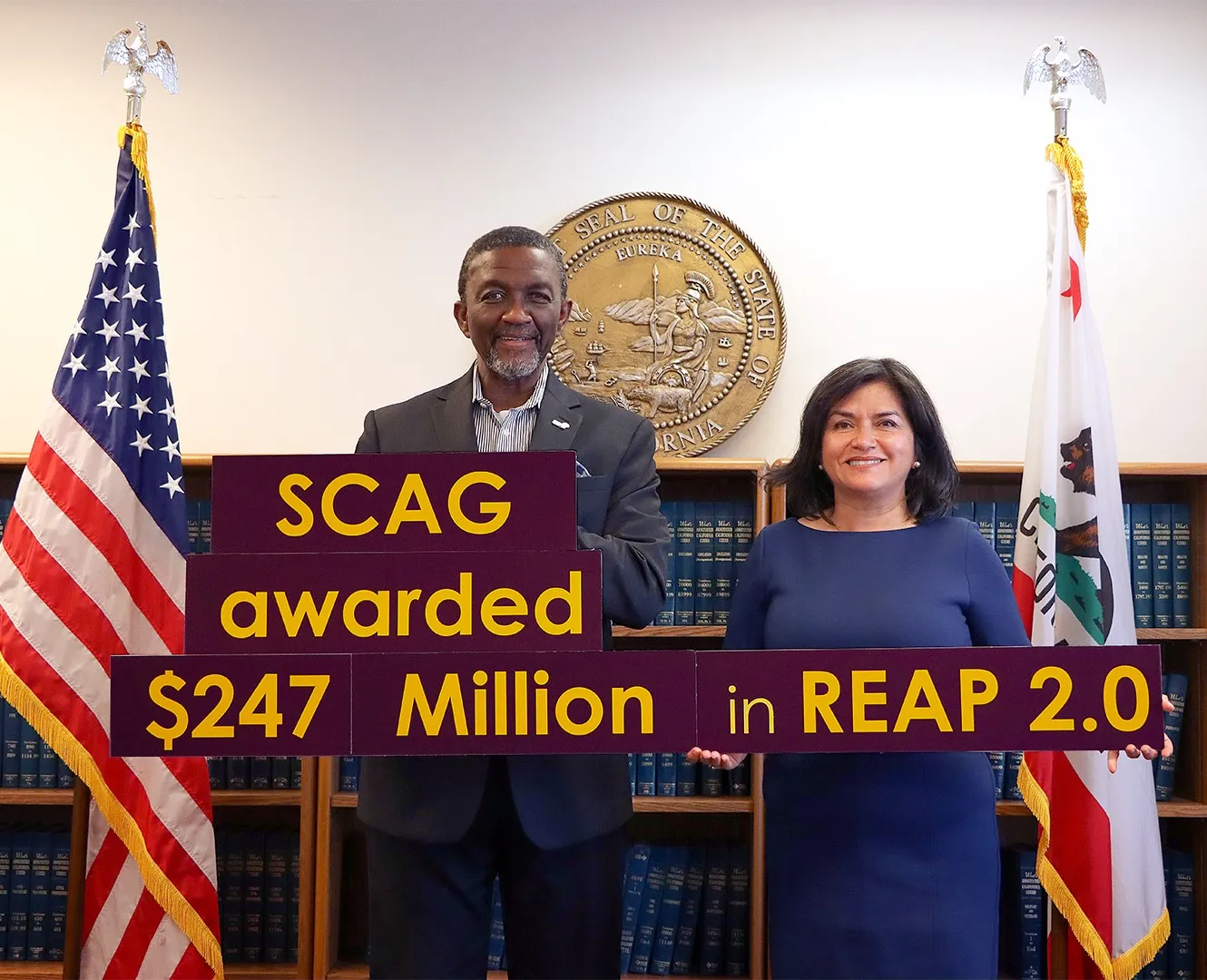
    BCSH Secretary Lourdes Castro Ramírez and SCAG Director Kome Asije mark the historic investment in the SCAG region to build more climate friendly housing in areas that will reduce car-dependency and meet our state housing goals.

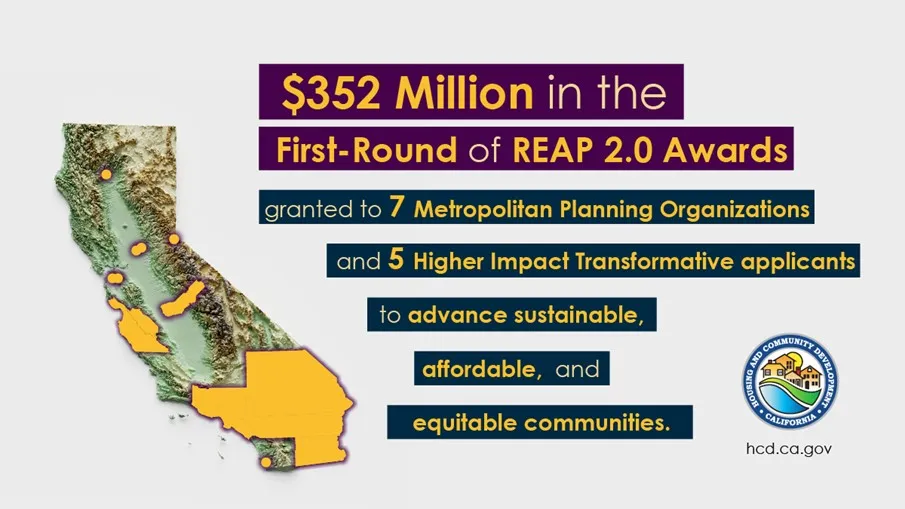
    The California Business, Consumer Services and Housing Agency announced today more than $352 million in the first round of funding from the Regional Early Action Planning grants program of 2021 (REAP 2.0).

    REAP 2.0 is a flexible grants program that represents California’s commitment to a future where everyone has the option to live closer to jobs, services, and daily destinations. It provides planning and implementation dollars to create sustainable, resilient, and equitable communities that are inclusive and take strong strides toward reducing vehicle miles traveled.

    “Abundant affordable housing is key to addressing the climate crisis,” said Business, Consumer Services and Housing Agency Secretary Lourdes Castro Ramírez. “California is proud to partner with local communities to build more affordable homes in the right places – near jobs, transit and neighborhood services–to mitigate the impact of climate change, improve people’s quality of life, and meet the state’s climate goals.” 

    Enacted as part of the California Comeback Plan, REAP 2.0 builds on the successes of the $125 million REAP 2019, while expanding the program’s focus by integrating housing and climate goals, and allowing for broader planning and implementation investments. This includes infrastructure investments that support infill development and facilitate housing supply and affordability. 

    The vast majority of $570 million in REAP 2.0 funds will flow to Metropolitan Planning Organizations (MPOs) statewide through an over-the-counter process; MPOs may then suballocate a portion to eligible local, regional, and tribal entities. A smaller set-aside of $30 million in REAP 2.0 Higher Impact Transformative (HIT) funding has been allocated through a highly competitive process to five awardees that have demonstrated a commitment to transforming disadvantaged neighborhoods in support of unique, innovative place-based projects. 

    “These highly competitive awards are going to communities that have demonstrated a strong commitment to transforming historically under-resourced communities,” said HCD Director Gustavo Velasquez. “High-impact REAP 2.0 grants will make possible the development of significant affordable housing near transit hubs, connecting vulnerable Californians to opportunity and moving the state toward its climate goals by reducing vehicle traffic.” 

    Map of California showing regions that received REAP funding. Text reads: $352 million in the first round of REAP 2.0 awards granted to 7 metropolitan planning organizations and 5 higher impact transformative applicants to advance sustainable, affordable and equitable communities.

    Awardees receiving a total of more than $322 million in the first round of REAP 2.0 MPO funding include: 

    Association of Monterey Bay Area Governments (AMBAG), which will split nearly $9.13 million in REAP 2.0 funds between two regional suballocation programs and a technical assistance program. AMBAG will provide 60 percent of its funding to a competitive grant program for local jurisdictions with the most high-impact and transformative projects. AMBAG will also directly suballocate 25 percent of the total award to all local jurisdictions based on Regional Housing Needs Assessment (RHNA) distribution to fund REAP 2.0-eligible implementation or planning projects. AMBAG will use the remaining funding to administer a technical assistance program for local jurisdictions to help increase planning capacity with the goal of advancing best practices for reducing vehicle miles traveled based on the regional Sustainable Community Strategy (SCS). 

    Madera County Transportation Commission (MCTC), which will spread out its $2.18 million award to the City of Chowchilla, the City of Madera, and the County of Madera to fund transformative projects that support disadvantaged communities, regional connectivity, and infill affordable housing along multimodal corridors. 

    Sacramento Area Council of Governments (SACOG), which will use its $31.83 million award to fund the Green Means Go program, providing one-time funding to local cities and counties for planning and capital infrastructure investments for non-transportation projects in locally adopted Green Zones (priority growth areas). 

    San Diego Association of Governments (SANDAG), which will split its $38.73 million award between affordable housing development, the establishment of an affordable housing trust fund, and three separate suballocation programs: one to local jurisdictions for planning and capital investment; one to transportation agencies for studies and predevelopment work to create mobility hubs; and one to tribal entities for predevelopment plans, studies, and outreach materials for housing proposals. 

    Shasta Regional Transportation Agency (SRTA), which will use its $2.24 million award to develop two infill sites for housing affordable to low- and moderate-income households and to make infrastructure improvements to provide greater connectivity and more transportation options in Downtown Shasta Lake. 

    Southern California Association of Governments (SCAG), which will receive the largest REAP 2.0 award to date, with $237.41 million supporting a wide range of projects. SCAG will contribute more than $99 million to Programs to Accelerate Transformative Housing (PATH) in support of a Notice of Funding Availability for Lasting Affordability; a Regional Utilities Supporting Housing Pilot Program; and a Housing Infill on Public and Private Lands Pilot Program. Another $100 million will go to the Transformative Partnership Program (TPP) to be split between its County Transportation Commission Partnership Program (CTC) and Regional Pilot Initiatives Program (RPI). SCAG will suballocate funds to cities and counties, based on population, to support the implementation of housing element programs and strategies that achieve all REAP 2.0 program objectives. Remaining SCAG REAP 2.0 funds will support the Sustainable Communities Program: Civic Engagement, Equity, and Environmental Justice (SCP: CEEEJ), as well as a major data purchase that will help local jurisdictions create a disadvantaged communities toolkit, a regional performance measurement dashboard of key regional performance indicators, and a centralized hub to engage and request information, technical assistance, and training on the tools and resources in the regional data platform. 

    Tahoe Regional Planning Agency (TRPA), which will use its $567,239 award to update density, height, and coverage regulations to facilitate multifamily development and accessory dwelling units, increasing housing supply, choice, and affordability in the region. 

    REAP 2.0 HIT awardees are: 

    City of Oakland, which will invest $10 million in REAP 2.0 funds in West Oakland around the Mandela BART Station. This includes conducting predevelopment activities for the Bay Area’s largest planned 100-percent affordable infill project, as well as installing infrastructure such as sewer lines that will support 2,705 units of housing (including 418 affordable units), 300,000 square feet of commercial space, and over 100,000 square feet of retail space adjacent to the Mandela BART Station. REAP 2.0 funds will also be used to complete the design phase for complete streets improvements on 7th Street and implement a "Universal Basic Mobility" transit fare subsidy program – providing prepaid debit cards for multiple transit agencies and mobility services for select West Oakland residents. 

    City of Rancho Cordova, which will receive a $4 million REAP 2.0 HIT award to make non-transportation infrastructure improvements that will support transit-oriented development around the Mather Mills Light Rail Station, which will facilitate the completion of 60 affordable housing units and 120 housing units total, with up to 400 homes and other community-serving uses anticipated in the project area. 

    Tahoe Regional Planning Agency (TRPA), which will use $2,412,475 in REAP 2.0 HIT funds to develop an environmental clearance process for infill multifamily developments and analyze and update the region’s Transfer of Development Rights and growth management programs to incorporate equity, address climate change concerns, and facilitate infill development. 

    SANDAG will invest $10 million along the Trolley Blue Line for Transforming and Advancing South County Transit Communities (TASC), which includes infrastructure investments to support a 483-unit transit-oriented affordable and middle-income housing project and other community serving uses (Palm City Transit Village), Capital Improvements to convert an automobile alleyway into a multimodal corridor linked to the trolley station by removing a vehicle lane for active transportation and arts, and establishing the Avanzando Community Land Trust of 103 units with 15-year rent-to-own opportunities for households with incomes that are 30-60 percent of the area median income. 

    BART will receive nearly $3.59 in REAP 2.0 HIT funds to establish a revolving loan fund to finance predevelopment activities for affordable housing projects on BART-owned land. The initial loan will be made to the Lake Merritt/Chinatown transit-oriented development senior affordable housing project as part of a larger place-based planning strategy in the area. 

    REAP 2.0 is administered by HCD in collaboration with the Governor’s Office of Planning and Research, the Strategic Growth Council, and the California Air Resources Board. 

    BCSH Logo  HCD Logo

  • Press Release
  • Affordable Housing
  • REAP
  • Climate Mitigation
  • July 5, 2023
    Local and regional agencies will fund investments to advance sustainable and equitable communities and facilitate infill housing development
    HCD Press Office
    Off
    Article
    Top