
January 2026
Transit-Oriented Community Opens in San Jose
Off

Climate and housing leaders and community members gathered to celebrate the opening of Tamien Station Apartments, a new affordable housing development in San Jose. Tamien Station provides 135 new homes just steps from public transit – which adds to the state’s affordable housing portfolio while helping to reduce greenhouse gas emissions.
Tamien Station was supported by HCD’s Infill Infrastructure Grant program and the Affordable Housing and Sustainable Communities Program jointly administered by HCD and the Strategic Growth Council.
Read more: https://www.hcd.ca.gov/about-hcd/newsroom/tamien-station-apts
January 28, 2026
On
https://www.youtube.com/watch?v=VIVycQmpxBY
Video
Career Fairs and Information Sessions
No career fairs or information sessions at this time. Check back for updates!
Subscribe to receive weekly job notifications.
California climate and housing leaders celebrate opening of 135 state-funded affordable, sustainable homes in San Jose
Off
San Jose, CA

California state representatives joined local officials and partners today to celebrate the grand opening of Tamien Station Apartments, a new affordable housing community just steps from convenient public transit and everyday needs.
The apartment complex, built on land owned by the Santa Clara Valley Transportation Authority (VTA), adds 135 much-needed affordable housing units south of downtown San Jose and is conveniently located right next to the Tamien Caltrain and light rail station. The development is the first transit-oriented development housing to open in more than 20 years under the portfolio of the VTA.
“Tamien Station Apartments demonstrates exactly what the Strategic Growth Council is working to achieve in California - thriving neighborhoods with walkable, affordable communities near public transit,” said California Strategic Growth Council (SGC) Executive Director Erin Curtis. “With easy transportation options and on-site amenities - including a day care, food pantry and community gathering spaces – this new complex promises to enhance quality of life across the board for the neighborhood.”
“Our tremendous partnership with the Strategic Growth Council and the power of cap-and-invest strengthen our ability to meet California’s most critical housing needs,” said Gustavo Velasquez, Director of the California Department of Housing and Community Development. “This project embodies the innovative spirit with which Governor Newsom has led focused action on affordable housing, leading to the state’s largest reduction in homelessness in 15 years.”
The development was partially funded by a $28.7 million grant from the Affordable Housing and Sustainable Communities Program jointly administered by SGC and HCD. AHSC is part of California Climate Investments, a statewide program that puts billions of cap-and-invest, formerly known as cap-and-trade, dollars to work reducing greenhouse gas emissions, strengthening the economy, and improving public health and the environment — particularly in disadvantaged communities.
Another $3 million in funding came from HCD’s Infill Infrastructure Grant program, which funds needed infrastructure improvements that make development of critically needed affordable housing possible.
About the Development
Developed by The Core Companies, Tamien has studio, one-, two- and three-bedroom apartments reserved for households making 60% or less of the median income for Santa Clara County. That translates to a four-person household earning less than $117,000 a year.
Half of the units in the development are allocated for rapid rehousing to help those most in need access safe housing and avoid homelessness.
Access to transportation, downtown, jobs, parks and shopping—along with on-site amenities such as a day care center, a rooftop playground, a fitness room, laundry, a homework room and a food pantry—make the complex a holistic, accessible community.
“The idea behind transit-oriented development is to build housing near public transportation hubs, so residents can drop off their kids at the on-site day care, jump on a train or light rail to go to work, or get to shops, doctor’s visits, and businesses without a car,” said Curtis. “That means a more comfortable, healthy and affordable lifestyle for families, while reducing traffic congestion and carbon emissions for the larger community. Taking the train beats the stress of stop and go freeway traffic any day!”
The 1.6-acre site was previously a VTA-owned parking lot, and the development is part of VTA’s effort to build transit-oriented communities—mixed-use, mixed-income neighborhoods connected by transit, supporting walkability, cycling, and long-term sustainability. It is now leased to Urban Co Tamien LLC, a partnership between Core and Republic Urban Properties, generating revenue to support transit services while providing affordable housing. This is the first phase of a mixed-income neighborhood development that will create a total of 555 units on the site.
Impact of California Climate Investments
The SGC recently surpassed a milestone of $5 billion in investments statewide – much of it funded by California Climate Investments.
The SGC investments:
- Fund affordable housing and transportation projects close to jobs, schools, and other daily destinations.
- Build climate resilience through protecting our productive farmlands and encouraging compact transit-oriented communities.
- Support community-led climate solutions that achieve major environmental, health, and economic benefits in California’s most disadvantaged communities.
California Climate Investments funding is part of the state’s cap-and-invest program, which requires polluters to buy allowances for the greenhouse gases they emit. The funding puts billions of dollars to work reducing greenhouse gas emissions, strengthening the economy, and improving public health and the environment — especially in disadvantaged communities.
California Climate Investments includes 117 programs administered by 27 state agencies, with funding directly supporting the governor’s work to build a California for All, meeting the housing needs throughout the state while also protecting California’s climate.
California is using California Climate Investment funds to protect health, stability, and opportunity across the state.
A Housing Approach that works
From the very first moments of the Newsom administration, the national crisis of housing and homelessness – which were decades in the making – has been addressed with ingenuity, seriousness, and expertise. No other state has devoted as much time and attention to these twin problems – and California is a leader in producing positive results. Governor Newsom is creating a structural and foundational model for America:
✅ Addressing mental health and its impact on homelessness — Ending a long-standing 7,000 behavioral health bed shortfall in California by rapidly expanding community treatment centers and permanent supportive housing units. In 2024, voters approved Governor Newsom’s Proposition 1 which is transforming California’s mental health systems with a $6.4 billion Behavioral Health Bond for treatment settings and housing with services for veterans and people experiencing homelessness, and reforming the Behavioral Health Services Act to focus on people with the most serious illness, provide care to people with substance disorders, and support their housing needs.
✅ Creating new pathways for those who need the most help — Updating conservatorship laws for the first time in 50 years to include people who are unable to provide for their personal safety or necessary medical care, in addition to food, clothing, or shelter, due to either severe substance use disorder or serious mental health illness. Creating a new CARE court system that creates court-ordered plans for up to 24 months for people struggling with untreated mental illness, and often substance use challenges.
✅ Streamlining and prioritizing building of new housing — Governor Newsom made creating more housing a top state priority for the first time in history. He has signed into law groundbreaking reforms to break down systemic barriers that have stood in the way of building the housing Californians need, including broad CEQA reforms.
✅ Creating shelter and support — Providing funding and programs for local governments, coupled with strong accountability measures to ensure that each local government is doing its share to build housing, and create shelter and support, so that people rescued from encampments have a safe place to go.
✅ Removing dangerous encampments — Governor Newsom has set a strong expectation for all local governments to address encampments in their communities and help connect people with support. In 2024, Governor Newsom filed an amicus brief with the Supreme Court defending communities' authority to clear encampments. After the Supreme Court affirmed local authority, Governor Newsom issued an executive order directing state entities and urging local governments to clear encampments and connect people with support, using a state-tested model to address encampments humanely and provide people with adequate notice and support.
Reversing a decades-in-the-making crisis
The Newsom administration is making significant progress in reversing decades of inaction on homelessness. Between 2014 and 2019—before Governor Newsom took office—unsheltered homelessness in California rose by approximately 37,000 people. Since then, under this Administration, California has significantly slowed that growth, even as many other states have seen worsening trends.
In 2024, while homelessness increased nationally by over 18%, California limited its overall increase to just 3% — a lower rate than in 40 other states. The state also held the growth of unsheltered homelessness to just 0.45%, compared to a national increase of nearly 7%. States like Florida, Texas, New York, and Illinois saw larger increases both in percentage and absolute numbers. California also achieved the nation’s largest reduction in veteran homelessness and made meaningful progress in reducing youth homelessness.
About the California Strategic Growth Council
The SGC is part of the governor’s Cabinet, a team of state leaders who work closely with the governor to advance sustainability, equity, and quality of life across California—connecting housing, transportation, climate, and community investment.
The 10 distinguished members of the council include state-agency secretaries and directors, and three appointed members of the public. The Director of the Governor’s Office of Land Use and Climate Innovation acts as its chair.
The collaborative structure of SGC provides a pathway for broad implementation across state agencies to prioritize uplifting community voices into the type of projects and resources to receive state funds.
About the California Department of Housing and Community Development
HCD helps to provide stable, safe homes affordable to veterans, seniors, young families, farmworkers, tribes, people with disabilities, and individuals and families experiencing homelessness so that every California resident can live, work, and play in healthy communities of opportunity. Since 2019, the Newsom Administration has invested over $15.4 billion through HCD’s many programs to fund development of more than 66,000 affordable multifamily rental homes across the state, including those at Tamien Station.
January 23, 2026
Pablo Espinoza
Off
Deputy Director of Communications
Article
HCD in Focus: Wrapping up a Year of Record Investments and Housing Development
Off
“HCD In Focus” is a news in review that highlights the impact of HCD administered programs on the lives of Californians.
Video highlights: Governor Gavin Newsom announced a series of awards to help mitigate disaster risk in local communities and help build permanent supportive homes, affordable rental homes and accessory dwelling units throughout the state; Multiple grand openings and groundbreakings of affordable housing communities serving low-income families, seniors, farmworker families, disaster survivors, people with special needs and people exiting homelessness. Spotlights on resident Briana of HCD-funded Crescent Grove apartments and HCD team member Emilie Hill.
January 22, 2026
On
https://www.youtube.com/watch?v=IRZ2SLidco0
Video
Two New Homekey Projects Open in Long Beach
Off

HCD joined residents, local leaders, and community partners to celebrate the grand openings of two new Homekey projects in Long Beach: Zephyr and Crescent.
Named after butterflies to symbolize transformation and renewal, these developments provide permanent supportive housing for individuals and couples experiencing homelessness with incomes at or below 30 percent of the Area Median Income. Together, Zephyr and Crescent have created 177 new homes that will lift local residents out of homelessness and into a safe community.
“Together, Zephyr and Crescent demonstrate how Long Beach and Los Angeles County are leveraging Homekey to tackle the region’s housing shortage head-on, creating pathways to healing, belonging, and hope,” said Linc Housing President and COO Suny Lay Chang.
Zephyr
Formerly a Holiday Inn, Zephyr was initially used by Los Angeles County as interim housing, offering 137 temporary units. The County later partnered with Linc Housing to convert the site into permanent supportive housing, made possible by nearly $21 million in Homekey funding from HCD.
Zephyr now offers 135 permanent homes for people who have experienced homelessness, along with two units for on-site managers. Residents benefit from project-based Section 8 vouchers provided by the Long Beach Housing Authority and receive comprehensive wrap-around services from Linc Housing, including case management and supportive care.
Crescent
Crescent, previously a Motel 6, followed a similar path. After serving as interim housing, the site was redeveloped by Linc Housing into 39 affordable homes and one manager’s unit. As with Zephyr, Crescent residents receive project-based Section 8 vouchers and access to a wide range of supportive services, including:
- Mental and physical health care,
- Employment counseling and job placement,
- Educational support, and
- Substance use counseling.
Crescent’s primary funding came from a $6.6 million award from HCD’s Homekey program.
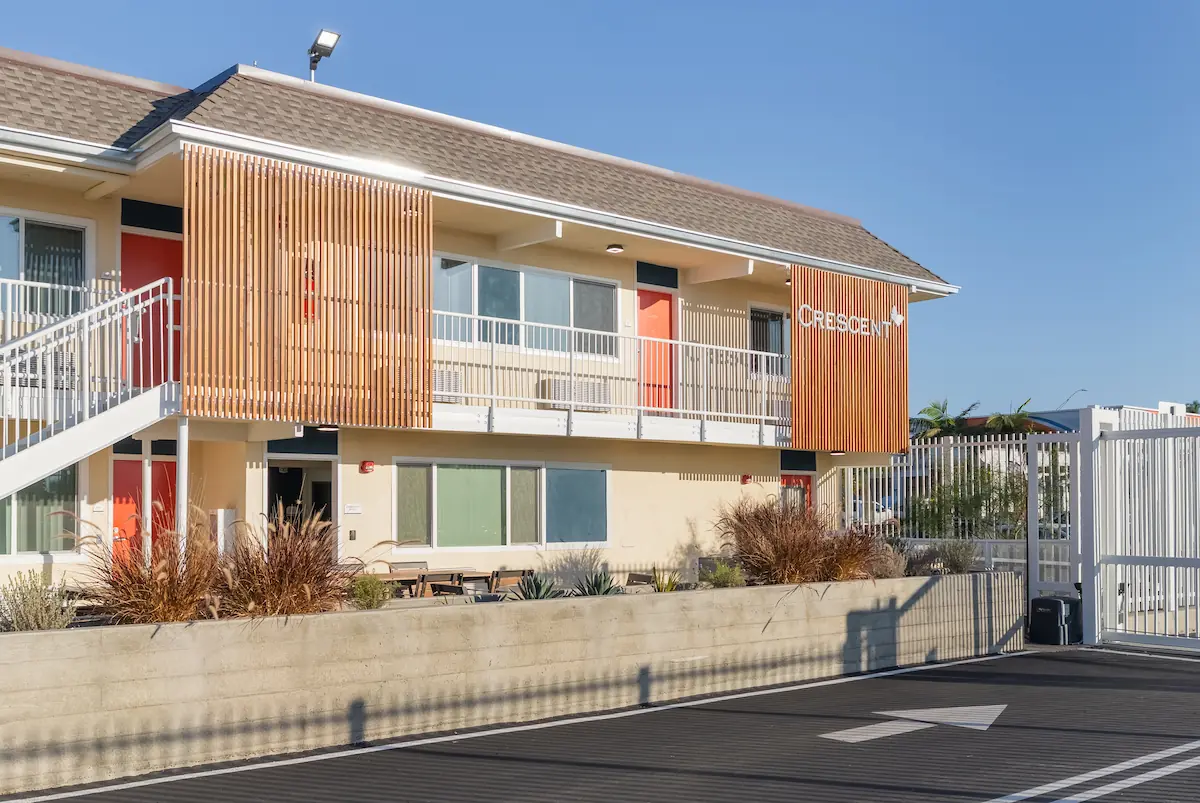
“The state’s Homekey program has been a game changer for us,” said Los Angeles County Supervisor, Janice Hahn. “By partnering with Linc Housing and using state funding to convert these two buildings, we have 177 new apartments for the people who most need them in Long Beach.”
Both Zephyr and Crescent broke ground in March 2024 and were completed in just over a year. Together, they now provide safe, stable housing for 174 formerly unhoused households.
About Homekey
Across three rounds, HCD’s Homekey program supported the creation of nearly 16,000 interim and permanent supportive homes across California, expected to serve more than 172,000 people over the life of the projects. In Long Beach alone, Homekey has helped fund 358 homes. Modeled on the highly successful Homekey program, voter-approved Proposition 1-funded Homekey+ will build on that progress at scale statewide to advance the Governor’s vision to alleviate homelessness in California.
January 21, 2026
Off
Article
Treatment Not Tents
Off
Governor Gavin Newsom continues to combat homelessness by announcing new investments to create more shelter and services in Los Angeles, San Diego and San Francisco. Governor Newsom today announced $419 million in awards from HCD’s Homeless Housing, Assistance and Prevention (HHAP) program as well as highlighted key investments made through voter-approved Proposition 1.
January 16, 2026
On
https://www.youtube.com/watch?v=prG5ROkpZZg
Video
Following 9% drop in unsheltered homelessness, Governor Newsom announces new investments to create more shelter and services — with stronger accountability
Off
San Francisco, CA

As the Trump administration attacks public programs and seeks to slash funding for homelessness, Governor Gavin Newsom continues to advance effective programs that have led to California’s recent 9% reduction in unsheltered homelessness. Today, the Governor announced new state support for local communities with more than $419 million for San Francisco, Los Angeles and San Diego as part of the state’s Homeless Housing, Assistance and Prevention (HHAP) program. HHAP funding helps local programs end homelessness through supportive services and permanent and interim housing.
This adds to funding from Proposition 1, advanced by the Governor and approved by voters in 2024, to help local communities provide vital care and housing for those with mental and behavioral health needs. Governor Newsom is the first Governor to have prioritized new housing, homeless, and mental health programs, and is turning around the impacts of this national crisis impacting California, leading the first reduction in unsheltered homelessness in more than 15 years.
“We put Proposition 1 on the ballot because Californians are demanding we do more to confront the mental health crisis and the homelessness emergency head-on. Voters gave us the tools and we are putting them to work, delivering treatment, housing, and real support, and proving that this state can lead the way on a challenge facing the entire nation. Our state investments have launched critical programs for local communities. Together, we’re breaking cycles of homelessness that took decades to create — and we’re doing it with urgency, compassion, and accountability,” said Governor Gavin Newsom.
More support. More accountability
HHAP is a multi-year grant available to local communities to create permanent housing, sustain interim housing, and accelerate proven local interventions. The Newsom Administration, in partnership with the Legislature, made historic investments into the program, with nearly $5 billion appropriated through current and previous rounds of HHAP to support local jurisdictions in promoting housing stability and reducing homelessness.
“Through the HHAP program, we’re helping local governments address the unique needs in their communities, expand the supply of housing, and reduce homelessness across regions,” said California Business, Consumer Services and Housing Agency Secretary Tomiquia Moss. “Together, we’re paving the way to create more opportunities for our unhoused neighbors to stabilize and thrive.”
Today’s announcement awards the first funding from HHAP Round 6, with a total of $419 million to the Los Angeles, San Diego, and San Francisco regions. The awards announced today represent three of 42 regional applications submitted for HHAP Round 6, with additional awards expected in the coming months.
“Our Department is committed to delivering critical resources to jurisdictions that are working to solve homelessness through innovative solutions and proven best practices,” said HCD Director Gustavo Velasquez. “We will continue to ensure progress is being made to move residents into housing quickly and will hold grantees accountable to their promises, and to the people of California.”
HHAP Round 6 builds on enhanced accountability measures and responds to the Governor’s call to ensure funds have the greatest impact for Californians experiencing homelessness. These measures include requirements that grantees have and maintain a compliant housing element and mechanisms to claw back HHAP 6 funding from local governments that fail to demonstrate progress. For more information about how your community is performing in addressing housing, homelessness, and mental health care, visit www.accountablity.ca.gov.
In addition to the remaining funds from HHAP 6, there is a seventh round of HHAP totaling $500 million planned for the coming budget year, contingent on enhanced accountability and performance requirements. HHAP Round 7 will expand existing accountability metrics to ensure grantees make meaningful investments in housing solutions and adopt housing policies that will increase downstream housing supply, a critical tool in preventing future homelessness.
"In San Francisco, we are changing our approach to homelessness to get people off the streets and on a path toward stability. In December, we reached a record-low number of encampments—down 44% from 2024. But we can’t do this alone,” said Mayor Daniel Lurie. "The resources provided by the state are crucial—whether that’s Prop 1, HHAP dollars, or funding to make sure our freeway on-ramps and off-ramps are clean. I want to thank Governor Newsom for helping make that progress possible. We have more work to do, but we are now on the right track, and with strong partnerships and continued investment, we will keep moving forward."
The awards today as part of the first allocation from HHAP 6 include the following investments:
- San Francisco City and County and the Continuums of Care serving the city and county — $39.9 million to sustain operations and services for two semi-congregate shelters and three navigation centers through June 2029—serving more than 600 adults and 75 youth nightly—with additional support for the San Francisco Online Navigation and Entry System.
- Los Angeles County, the cities of Los Angeles and Long Beach, and four Continuums of care that serve Glendale, Long Beach, Los Angeles City and County, and Pasadena — $328.8 million to fund operations and services for interim housing (including for youth), services in permanent supportive housing, rapid rehousing and time limited subsidies, and encampment resolution efforts
- San Diego County, the City of San Diego, and the Continuums of Care serving the city and county — $50.9 million to fund existing emergency shelters and expand emergency shelter capacity—including through hotel/motel vouchers—in addition to significant investments in permanent housing solutions (rental subsidies, flexible housing resources, extended rapid rehousing, and prevention/diversion).
This adds to state investments to help local communities address homelessness since 2019 which have included the launch of the first-in-the-nation Homekey program that has created nearly 16,000 homes across 250 projects and reached over 172,000 Californians; $2.25 billion through Homekey+ to serve individuals with mental health or substance use challenges and veterans; $1 billion in Encampment Resolution Funds to provide services and housing to help 23,000 individuals across 120 encampment sites transition from homelessness.
Treatment, not tents
Today’s event, at the Friendship House in San Francisco, also highlights key investments through Governor Newsom’s Prop 1. More than 1.2 million adults in California live with a serious mental illness, and 1 in 10 residents meet the criteria for a substance use disorder. Additionally, shortages of behavioral health treatment sites contribute to rising rates of homelessness and incarceration among people with mental health disorders.
Prop 1 is transforming California’s mental health systems with a $6.4 billion Behavioral Health Bond for housing, services, and treatment for veterans and people experiencing homelessness. When fully awarded, funding from Proposition 1 bonds is estimated to create 6,800 residential treatment beds and 26,700 outpatient treatment slots for behavioral health.
Friendship House has operated residential and outpatient substance use disorder programs for more than half a century and serves more than 5,000 community members annually, with particular focus on Native American communities. The organization was recently awarded $31.4 million from Proposition 1, Round 1, Behavioral Health Continuum Infrastructure Program (BHCIP) to help build a new “Village SF Wellness Center” at 80 Julian Avenue. The project will offer holistic and culturally significant services and house 60 residential substance use disorder beds, 107 mental health outpatient slots and 100 wellness slots. This is critical funding for a $92 million, six-story building that will contain four floors of treatment and recovery services.
In addition to BHCIP funding, Prop 1 also creates new supportive housing through Homekey+. Approximately $1.033 billion in Proposition 1 bond funds are currently available through Homekey+ to cities, counties, housing authorities, and tribal entities for projects serving veterans. Another $1.11 billion is available for projects serving all target populations, through a combination of Proposition 1 bond funds and Homeless Housing, Assistance, and Prevention (HHAP) program funds.
Increasing affordability
The homeless crisis cannot be solved without creating more housing and making housing more accessible for Californians. This week, the state announced that the application period for the California Dream for All program, which provides up to 20% down payment assistance to first-generation homebuyers, will begin accepting applications on February 24. The program has helped thousands of Californians access their first home, and potential applicants should begin preparing their applications now. Learn more at calhfa.ca.gov/dream.
Reversing decades of inaction on homelessness
In 2019, during his first State of the State, Governor Newsom announced the state would begin focusing on the homelessness crisis — becoming the first Governor in history to make this issue a top statewide priority. Through new programs and funding, California is now outperforming the nation in turning around the decades-in-the-making homelessness crisis. While homelessness continues to increase nationwide, in 2025, California reduced its unsheltered homeless population by an estimated 9%.
Governor Newsom is creating a structural and foundational model for America:
✅ Creating shelter and support — Providing funding and programs for local governments, coupled with strong accountability measures to ensure that each local government is doing its share to build housing, and create shelter and support, so that people rescued from encampments have a safe place to go. This week, through a $77 million investment from the California’s cap and invest program, Los Angeles announced the expansion and redevelopment of the largest public housing project in the region, the Jordan Downs Project.
✅ Addressing mental health and its impact on homelessness — Ending a long-standing 7,000 behavioral health bed shortfall in California by rapidly expanding community treatment centers and permanent supportive housing units. In 2024, voters approved Governor Newsom’s Proposition 1 which is transforming California’s mental health systems. When fully awarded, funding from Proposition 1 bonds is estimated to create 6,800 residential treatment beds and 26,700 outpatient treatment slots for behavioral health care.
✅ Creating new pathways for those who need the most help — Updating conservatorship laws for the first time in 50 years to include people who are unable to provide for their personal safety or necessary medical care, in addition to food, clothing, or shelter, due to either severe substance use disorder or serious mental health illness. Creating a new CARE court system that creates court-ordered plans for up to 24 months for people struggling with untreated mental illness, and often substance use challenges.
✅ Streamlining and prioritizing building of new housing — Governor Newsom made creating more housing a top state priority for the first time in history. He has signed into law groundbreaking reforms to break down systemic barriers that have stood in the way of building the housing Californians need, including broad CEQA reforms.
✅ Removing dangerous encampments — Governor Newsom has set a strong expectation for all local governments to address encampments in their communities and help connect people with support. In 2024, Governor Newsom filed an amicus brief with the Supreme Court defending communities' authority to clear encampments. After the Supreme Court affirmed local authority, Governor Newsom issued an executive order directing state entities and urging local governments to clear encampments and connect people with support, using a state-tested model to address encampments humanely and provide people with adequate notice and support.
In August, just a year after he issued an executive order urging local governments to better address encampments, the Governor announced his SAFE Task Force to address encampments in California’s ten largest cities. In just a few months, the task force has addressed encampments in San Francisco, Los Angeles, Long Beach, Sacramento, and Fresno — connecting dozens of people with shelter. Since 2021, Caltrans has removed more than 19,000 encampments on state right-of-way and collected approximately 354,000 cubic yards of litter and debris.
January 16, 2026
Off
WHAT YOU NEED TO KNOW: California is driving the first statewide drop in unsheltered homelessness in over 15 years. Today, Governor Newsom is announcing $419 million in HHAP funding to expand housing and services across the Bay Area, Los Angeles, and San Diego — alongside billions in Proposition 1 funding.
Article
CA State Auditor Finds HCD Meets Deadlines on Housing Element Reviews and Provides Jurisdictions Consistent, Detailed Feedback and Guidance
Off
Sacramento, CA

The California State Auditor (CSA) today released a report on the Department of Housing and Community Development’s (HCD) procedures and oversight regarding housing element reviews, finding that HCD has met its statutory deadlines for reviewing housing elements and issuing findings. CSA also found that HCD generally provided consistent feedback among jurisdictions and letters sent to jurisdictions were precise, measurable, and criteria based.
California requires all cities and counties to complete a housing element, or housing plan, that will adequately plan for their fair share of the statewide housing need at all income levels. HCD reviews each housing element to determine whether it complies with state law and then submits written findings back to each local jurisdiction. HCD’s approval is required before a local jurisdiction can adopt its housing element as part of its overall general plan.
HCD provides technical assistance and resources to help local jurisdictions create comprehensive housing elements. The report recognizes that HCD provides many forms of guidance to local jurisdictions, which include memos, a comprehensive online how-to guide titled Building Blocks, and other online resources, and that the guidance is sufficiently detailed. CSA also reports that a combination of HCD’s written findings and individualized assistance allows local jurisdictions to understand and make necessary revisions to their housing elements.
“HCD’s Housing Accountability Unit and housing element reviewers have worked tirelessly to help local jurisdictions adopt housing plans that meet both legal requirements and the needs of their residents, reaching 90-percent housing element compliance in the 6th RHNA cycle,” said HCD Director Gustavo Velasquez. “I am pleased the California State Auditor recognizes HCD’s commitment to providing timely, consistent, and constructive feedback to local jurisdictions as we continue to implement Newsom Administration housing reforms to deliver much-needed housing.”
The scope of the audit covered the 6th housing element cycle. As noted in the report, HCD experienced extreme workload conditions for a two-year period during the 6th housing element cycle. The 6th cycle posed unique challenges for local governments and HCD, as many new statutory requirements went into effect and there was a 33-percent surge in housing elements submitted from the 5th cycle. From August 2021 to August 2023, HCD reviewed 1,049 housing elements for 389 jurisdictions, often managing reviews for two-thirds of the state at the same time. Despite these challenges, HCD successfully supported jurisdictions in achieving a record level of compliance. As of January 12, 2026, 90.2 percent of jurisdictions have adopted housing elements found to be in compliance with state law.
HCD largely agrees with the CSA findings and recommendations and will implement suggested changes to strengthen the program. Visit the California State Auditor website to view the report.
January 15, 2026
Report recommends legislative action to reduce workload spikes and additional internal actions to further improve process efficiency
Pablo Espinoza
Off
Deputy Director of Communications
Article
Top