July 2026

Retired Nurse Aide Finds a Home at Homekey-funded Moonstone

Off
Newsroom Default Image

For 10 years, retired nurse aide Debbie had to find a new place to sleep every night. After helping people for more than 30 years, Debbie finally received help in return. She is now off the streets and in a new home at HCD-funded The Moonstone apartments in Redondo Beach. The Moonstone is supported by more than $7.3 million from HCD’s Homekey program.

  • Homekey
  • Success Stories
  • July 27, 2026
    On
    Video

    Governor Newsom delivers $109.6 million in voter-approved Prop 1 funding for 278 supportive homes, including housing for veterans

    Off
    Sacramento, CA
    graphic of man hunched over and sad standing up and walking toward the light which displays housing and health services. Text reads: Today’s Homekey+ awards totaling $109.6 million will fund 278 affordable permanent supportive homes in 4 California communities for veterans and others with behavioral health challenges.

    Governor Gavin Newsom announced today the creation of 278 new permanent supportive homes in the communities of Bakersfield, Contra Costa County, Fresno, and Sacramento, including 103 homes reserved for veterans through $109.6 million in Prop 1-funded Homekey+ awards. The investments build on the state's ongoing work to reduce homelessness by expanding behavioral health services, while strengthening support for veterans across the state.

    “Every Californian deserves a safe place to call home, including the veterans who bravely served our country. California voters approved Proposition 1 because they know we must do more to address homelessness and behavioral health challenges. These Homekey+ investments are delivering on that promise by creating supportive housing, connecting people to care, and helping veterans and other Californians move toward stability,” said Governor Gavin Newsom.

    Today’s announcement is part of the Newsom administration’s comprehensive strategy to address California's housing affordability and homelessness crisis by expanding permanent supportive housing, increasing access to behavioral health services, and helping people move off the streets and into stable housing with the support they need to succeed. 

    “Investments through Homekey+ aren’t just numbers on a spreadsheet. Today’s awards will directly lead to the development of hundreds of affordable homes for California’s veterans and those experiencing behavioral health challenges,” said California Housing and Homelessness Agency Secretary Tomiquia Moss. “These investments would not be possible without the support of California voters and our key interagency partners. Together, we will continue to help build brighter futures and deliver tangible results for those with the greatest need.” 

    To date, Homekey+ has allocated $968.4 million to support 54 permanent supportive housing projects. These projects will create 2,749 affordable homes throughout California for individuals with behavioral health challenges who are experiencing or at risk of homelessness. Of these homes, 723 are reserved for veterans.  

    “Homekey+ continues to deliver real results for California veterans,” said CalVet Secretary Lindsey Sin. “With more than 700 veteran-designated homes now supported through this program, these investments represent more than new housing. They represent renewed opportunity, stability, and dignity for those who served our nation. Every additional Homekey+ project means more veterans will have a safe place to heal, rebuild their lives, and look toward the future with greater confidence.”

    Local investments with real results 

    Today’s funding will create affordable homes, with reserved units for veterans, in the following projects: 

    City of Sacramento: In partnership with Urban Capital LLC, will receive nearly $31.9 million from Homekey+ for the Rio Linda Senior Housing Project. The development will include 100 homes, including 49 homes dedicated to veterans experiencing homelessness with behavioral health challenges. The project serves seniors aged 55 and older. Sacramento and Urban Capital LLC will work in collaboration with BOSS Homes as the supplier of modular housing units. 

    Contra Costa County: In partnership with Satellite Affordable Housing Associates, will receive $28.8 million in Homekey+ funding for Choice in Aging, an 82-unit senior housing community with 62 units reserved for individuals at risk of homelessness with a behavioral health challenge. Of those 62 Homekey+ units, 30 homes will be reserved for veterans. In addition to Homekey+ funding, Choice in Aging received just over $6 million in November 2021 from HCD’s Veterans Housing and Homelessness Prevention Program. This award will be conditioned on the awardee providing proof of a low-income housing tax credit award no later than six months following the Homekey+ conditional award. 

    City of Fresno: In partnership with Parkway Prime LLC, will receive just under $32.6 million in Homekey+ funding to convert 106 interim housing units into 84 permanent supportive homes at Parkway Terrace. The interim housing project was a Round 2 Homekey project. The project will add critical resident amenities, including an upgraded on-site laundry facility, property management and case management offices, and reconfigured interior and exterior community spaces to support engagement and service delivery. Accessibility upgrades will include a modernized elevator and full ADA compliance across select units and common areas. Each unit will be updated with new kitchenettes, along with modern flooring, lighting, and bathroom fixtures. When complete, the project will reserve nine units for veterans. 

    City of Bakersfield: In partnership with Community Action Partnership of Kern, will receive just under $14.1 million from Homekey+ for the Ramkabir Permanent Supportive Housing Project. This acquisition and rehabilitation project will convert a 38-room motel into 30 permanent supportive homes, with 15 units reserved for veterans at risk of or experiencing homelessness with behavioral health challenges. In addition to its Homekey+ award, the project has committed funds of more than $1.1 million from the Homeless Housing Assistance Prevention Program, and a commitment of rental subsidies from Kern County Behavioral Health and Recovery Services and Housing Authority of the County of Kern. 

    In addition, three previously awarded veteran-serving projects in the cities of Olivehurst, Sanger, and Stockton will receive an augmentation totaling $2.3 million, largely for operating expenses based on a March 2026 Homekey+ NOFA amendment designed to incentivize more veterans’ units

    “Thanks to voter support of Governor Newsom’s vision for addressing homelessness among Californians facing behavioral health challenge, we are creating thousands of homes with supportive services to give veterans and others a stable foundation for a more hopeful future,” said HCD Director Gustavo Velasquez. “We are thrilled to see every project awarded today include homes reserved for our state’s military veterans, who are disproportionately impacted by homelessness after their service.” 

    The Homekey+ NOFA allocates funding by region based on a proportionate share of veterans and others experiencing homelessness, and by share of extremely low-income households whose rent is more than half of their income. There are also allocations for rural projects and for projects serving youth experiencing or at risk of homelessness. Homekey+ applications will continue to be reviewed and approved on a rolling basis.

    Adding to hundreds of pieces of legislation signed since 2019, and groundbreaking CEQA reform enacted last year, last week Governor Gavin Newsom signed housing trailer bill legislation as part of the 2026–27 State Budget that advances the next major phase of California’s housing strategy. The legislation modernizes how California finances and delivers affordable housing and builds on the Governor’s efforts that have reversed decades of inaction on housing and homelessness — creating more affordable homes and achieving the largest reduction in unsheltered homelessness in more than 15 years.

    Prop 1 in action: expanding supportive housing 

    Today’s awards continue the implementation of Proposition 1 while expanding permanent supportive housing for Californians experiencing or at risk of homelessness and living with behavioral health challenges. According to the 2025 Annual Homelessness Assessment Report published by the U.S. Department of Housing and Urban Development, California reduced unsheltered homelessness by 8,391 people, or 6.8% — more than any other state.   

    More than 1.2 million adults in California live with a serious mental illness, and 1 in 10 residents meet the criteria for a substance use disorder, increasing their risk of homelessness. Proposition 1 is helping California transform its behavioral health system with a $6.4 billion Behavioral Health Bond to expand housing, services, and treatment for veterans and others experiencing homelessness. Once completed, Prop. 1 projects are expected to add more than 6,900 residential treatment beds and 27,500 outpatient treatment slots for behavioral health. 

    The Homekey+ NOFA made approximately $1.03 billion in Proposition 1 bond funds available for permanent supportive housing projects serving veterans, and another $1.11 billion in Proposition 1 and Homeless Housing Assistance and Prevention Program funds available for projects serving all target populations.

    Reversing decades of inaction  

    This work has created immediate, measurable results and the critical foundation necessary to finally solve California’s housing and homelessness crisis. Governor Newsom’s policies have had a significant impact, as indicated by new federal data: 

    • Historic drops in homelessness — California achieved the largest statewide reduction in unsheltered homelessness in 16 years. New federal data also shows California last year saw:
      • Largest reduction in unsheltered homelessness in the nation. California reduced unsheltered homelessness by 8,391 people, or 6.8% — more than any other state. That decline is more than twice the national reduction of 2.9% and significantly exceeds that of the next-largest state by population, Texas, which saw a 1.4% decrease.  
      • Total homelessness declined. California’s overall homeless population dropped by 2.8%,— the state’s largest numerical decline since 2009. 
      • Leading the nation in reducing homelessness in key populations. From 2023 to 2025, California ranked first among all states and the District of Columbia in reducing the numbers of veteran homelessness, chronic homelessness, homelessness among young adults ages 18-24, and homelessness among parents under 25. 

    In addition, Governor Newsom is addressing a housing shortage that has been decades in the making. Since 2019:

    • Building is happening faster — Annual residential construction has increased by 59%, from 70,000 homes built in 2018 to about 111,000 in 2024. 
    • Multifamily construction has reached its highest level in decades — Over the last five years, more multifamily housing units have been built than in any five-year period in over 30 years, and more than 682,000 homes overall have been built statewide since 2019. 
    • Approval times have been slashed — Streamlining laws enacted since 2019 have cut average time from development application to entitlement by 57%, from 160 days to 68 days in 2024. The time from entitlement to permit also dropped by 9%. 
    • Communities are ready to build more — Through Governor Newsom’s work to ensure all jurisdictions do their part, communities throughout the state have laid the groundwork and have planned to accommodate at least 3.6 million new homes, including 1.4 million affordable units, moving California closer to meeting its long-term housing needs.
  • Homekey
  • Press Release
  • July 23, 2026
    Off

    What you need to know: California is expanding permanent supportive housing through Prop 1-funded Homekey+ investments, helping veterans and Californians who are experiencing or at risk of homelessness access stable housing and behavioral health services.

    Article

    Stockton Expands Affordable Housing for Youth, Veterans, Seniors and Families

    Off
    exterior view of calaveras quarters complex

    The Prohousing City of Stockton is making bold strides in addressing homelessness and housing insecurity with several new affordable housing developments aimed at supporting transition-aged youth, veterans, large families and seniors.

    Calaveras Quarters

    Calaveras Quarters transformed a former motel into 68 permanent homes for transition-aged youth and young families at risk of or exiting homelessness. Developed by Delta Community Developers Corporation, the community was made possible through $24.3 million from HCD’s Homekey program.

    Designed to support youth aging out of the foster care system, Calaveras Quarters offers supportive services including life-skills training, education and employment support, and self-sufficiency programs.

    “This is about resources for our community, for our young people,” said California Assemblymember Rhodesia Ransom at the grand opening ceremony. “This is showing that we care and that we are willing to make the investments so that people do not have to continue to figure it out on their own.”

    Watch the grand opening video.

    La Passeggiata

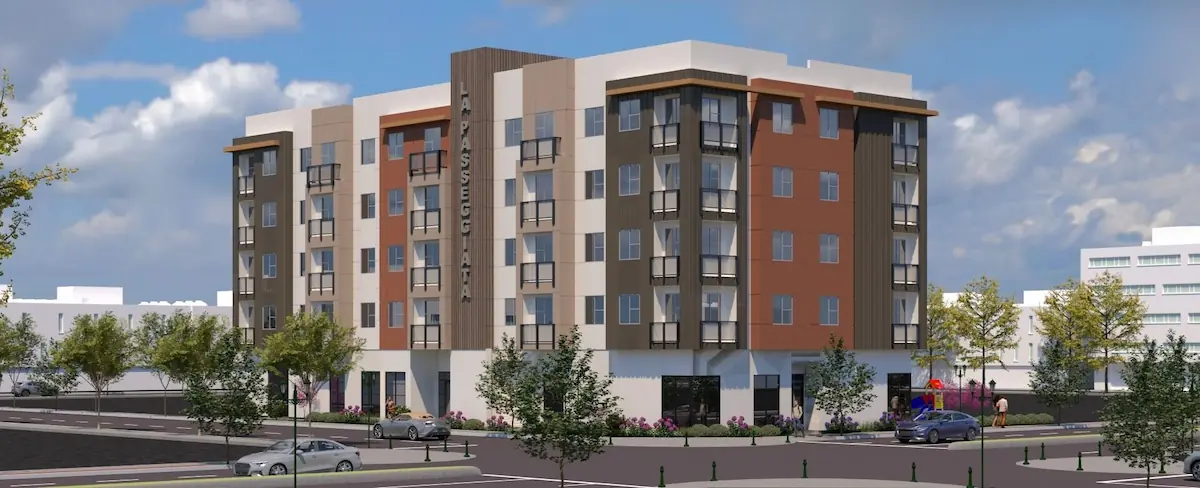
    Being built on state land, La Passeggiata will bring 94 affordable homes for large families and seniors to the region. The land for this project was made available through Governor Gavin Newsom’s 2019 executive order to identify excess land suitable for affordable housing development. A project of Visionary Homebuilders of California, La Passeggiata is funded by more than $31 million from HCD’s Multifamily Housing, Infill Infrastructure Grants and Excess Sites Local Government Matching Grants programs. The community will include indoor and outdoor community spaces such as a community room, computer and reading room, fitness center and children play area. 

    redering of la passeggiata

    Edison House

    One of the newest projects to break ground in the area is Edison House, a permanent supportive housing community located north of Downtown Stockton near American Legion Park. The project will convert a former non-residential commercial building into 33 homes for individuals at risk of or exiting homelessness and living with a behavioral health challenge, with 14 reserved for veterans. A project of the Housing Authority of the County of San Joaquin, Edison House is supported by more than $10.6 million from HCD’s Homekey+ program. Modeled after Governor Newsom’s highly successful Homekey program, Homekey+ was created with funding from voter-approved Proposition 1.

    rendering of edison house

  • Success Stories
  • July 21, 2026
    Off
    Article

    No more excuses: Newsom administration takes legal action against five California local governments for defying state housing law

    Off
    Oakland, CA
    California Attorney General Bonta and HCD Director Velasquez speaking at the press conference

    Moving to hold five California cities accountable for refusing to comply with state law requiring them to plan for their share of the state's housing needs, Governor Gavin Newsom today escalated the crackdown on local governments standing in the way of new housing.

    “California can't solve the housing crisis while some cities sit on their hands and dare us to do something about it. These five jurisdictions had every chance to follow the law and plan for their fair share of housing. They chose not to, so now they'll answer for it in court. Housing law applies statewide, and no city gets a pass,” said Governor Gavin Newsom.

    The actions filed today are part of the state’s plan to ensure every last jurisdiction does its part to solve for the state’s housing needs. With this sixth housing planning cycle nearing its end, the vast majority of jurisdictions have adopted a compliant housing element and met the requirements of the law. The jurisdictions named in today’s legal action are falling behind, with all at least two and a half years past the compliance deadline. The five cities are Calexico, Costa Mesa, Half Moon Bay, Ridgecrest, and Turlock. 

    “California’s housing crisis demands action, not excuses,” said Attorney General Rob Bonta. “Jurisdictions that remain out of compliance with our Housing Element Law are standing in the way of the homes Californians need. We are well past the halfway point of the current housing planning cycle, and timely compliance is not optional. As I’ve said many times, no local government has to solve this challenge alone, but every local government has to do its fair share. Today, we’re showing how serious we are about ensuring that every city and county in California adopts a housing element. Restoring the California dream will take an all-hands-on-deck effort.” 

    "The vast majority of California's cities and counties have stepped up to achieve housing element compliance," said HCD Director Gustavo Velasquez. "For the small number that are still falling short, the actions we are taking today should send a clear message: no community is exempt from doing its part to solve our housing crisis. Alongside Attorney General Bonta, Governor Newsom and HCD will continue to hold local governments accountable for complying with state law."

    Before making today's referral, HCD gave each jurisdiction repeated chances to fix the problem. That included formal notices of violation, 30 days for each city or county to respond in writing, and two rounds of meetings to work through solutions before the case ever reached the Attorney General's Office. Statewide, HCD's combination of technical assistance and enforcement has pushed housing element compliance above 95% in this cycle. 

    The state is prepared to file additional writ petitions against any city or county that receives a notice of violation from HCD and fails to act. 

    The law these cities broke 

    Since 1969, California has required every city and county to plan for housing at every income level, not just some, through a housing element, a required piece of each jurisdiction's general plan. Each cycle, HCD assigns every city and county a share of the state's housing need, and a jurisdiction's housing element must show, in specific terms, how it will meet that number and clear the barriers standing in the way. HCD reviews and must approve every housing element before it can be adopted. California is in its sixth cycle, with jurisdictions updating their plans every five or eight years. 

    The stakes aren't small. Under the state's Housing Accountability Act, an out-of-compliance jurisdiction is subject to the "Builder's Remedy," losing its ability to reject qualifying low- and moderate-income housing projects on zoning grounds. And under Senate Bill 1037, signed into law in 2024, jurisdictions are subject to civil penalties for noncompliance that go towards affordable housing in that same community. 

    The state has worked in lockstep on housing accountability throughout this cycle, an effort that has already produced settlements with Hollister, Artesia, La Habra Heights, Malibu, Fullerton, Coronado and San Bernardino, each committing to bring its housing element into compliance.

    Accountability in action: Huntington Beach 

    Today's action follows a May announcement on Huntington Beach, where the state sued the city in 2023 after it refused to update its housing element, more than four years past its legal deadline. In May 2026, a Superior Court judge ordered the city to pay $160,000 in penalties, with fines climbing to $50,000 a month until it comes into compliance. The case shows the consequences of willfully flouting the law. 

    More housing. More accountability. 

    Governor Newsom championed the creation of the Housing Accountability Unit at HCD to ensure cities and counties fulfill their legal responsibilities to plan and permit their fair share of housing. Since its establishment, the Housing Accountability Unit has supported the development of 13,541 housing units, including more than 3,852 affordable units, through enforcement actions and by working with local jurisdictions to ensure compliance with housing law. In 2024, the Unit was expanded to include a focus on homelessness issues, including compliance with state laws related to homeless housing. In addition to today's announcement and ongoing work to hold local governments accountable to help their residents and improve affordability, Governor Newsom is creating a structural and foundational model that will have positive impacts for generations to come. 

    The Governor is streamlining and prioritizing the building of new housing, funding new shelters, housing, and supports, holding local governments accountable, addressing mental health and its impact on homelessness through voter-approved Proposition 1, and creating new pathways for those who need it most through updated conservatorship laws and a new CARE court system. California is also addressing encampments statewide to help get people off the streets and into care. All this work is creating positive results. Last year, as a result of the Governor's strategies to address the housing and homelessness crisis, for the first time in over 15 years, California's unsheltered homelessness decreased by 9.5%. While other states and the nation as a whole continue to see homelessness rising, California is reversing a crisis decades in the making.

  • Accountability
  • Press Release
  • July 16, 2026
    Off

    What you need to know: California is suing five cities for repeatedly refusing to plan for their fair share of housing, the latest move in Governor Newsom's push to hold local governments accountable for the state's housing shortage.

    Article

    More Housing, Faster: Governor Newsom signs historic housing affordability reforms

    Off
    Oakland, CA
    Governor Newsom holding signed legislation before crowd.

    Adding to hundreds of pieces of legislation signed since 2019, and groundbreaking CEQA reform enacted last year, today Governor Gavin Newsom signed housing trailer bill legislation as part of the 2026–27 State Budget that advances the next major phase of California's housing strategy. The legislation modernizes how California finances and delivers affordable housing and builds on the Governor’s efforts that have reversed decades of inaction on housing and homelessness — creating more homes and the largest reduction in unsheltered homelessness in more than 15 years. 

    These investments come as part of the 2026-27 balanced budget that ensures a $0 deficit, this year and next, while protecting key state programs such as the Housing Homeless Assistance and Prevention (HHAP) program.

    “When I took office in 2019, my goal was clear: to reverse decades of inaction on housing and homelessness and ensure there was enough housing and care for people to leave the streets. Through historic investments, stronger partnerships, and greater accountability, we're seeing real progress that will benefit Californians not just today, but for generations to come. I’m grateful for the Legislature’s partnership, as together we add to this proven foundation with new laws that cut red tape, expand financing opportunities, and help communities build housing faster. Every Californian deserves a place to call home, and through this work, we're turning that goal into reality,” said Governor Newsom.

    Announcing groundbreaking new reforms 

    These reforms will help stretch existing dollars further and come alongside the passage of the historic $11.25 billion Veterans and Affordable Housing Bond Act of 2026, proposed for voter approval later this year. Through the legislation signed today, the Governor and the Legislature are: 

    • Modernizing California's housing finance system through landmark One-Stop Shop reforms that streamline project delivery, reduce duplicative reviews, and accelerate affordable housing production. 
    • Reducing the cost of building affordable housing by an estimated $60,000 to $70,000 per unit through One-Stop Shop financing reforms and impact fee changes, enabling state housing dollars to finance significantly more homes and maximize the impact of future housing investments. 
    • Creating a new Disaster Rebuilding Fund (DRF) — Directs $100 million in funding to reduce financing costs for homeowners rebuilding after disasters, helping affected households repair or reconstruct homes more quickly and affordably. 
    • Extending HHAP— Includes $900 million in FY 2026-27 for another round of state homelessness block grant funding while strengthening accountability through new local matching requirements and Prohousing requirements for direct HHAP recipients that are cities with populations over 300,000 and the counties in which those cities are located, encouraging greater local investment and policies that support housing production. 
    • Providing multifamily affordable housing resources — Includes $500 million for enhanced state low-income housing tax credits (LIHTC) and $200 million for the Multifamily Housing Program to support the construction and preservation of affordable multifamily housing for low-income Californians.

    Since 2019, the Newsom administration has created unprecedented policy and structural changes in state government to help California better address its housing and homelessness crises, including additional and unprecedented support for local governments, stronger accountability, and enforcement, transformational changes to mental health services. This also includes groundbreaking reforms like the legislative reforms signed last year that deliver foundational changes to break down systemic barriers and help ensure California can meet the housing needs of current and future generations. These changes have helped connect hundreds of thousands of people at risk of or experiencing homelessness with vital supports. 

    Reversing decades of inaction 

    This work has created immediate, measurable results and the critical foundation necessary to finally solve California’s housing and homelessness crisis. Governor Newsom’s policies have had a significant impact: 

    • Historic drops in homelessness — The largest statewide reduction in unsheltered homelessness in 16 years, with a 9% reduction in unsheltered homelessness across 30 continuums of care that reported updates in 2025. New federal data also shows California last year saw: 
      • Largest reduction in unsheltered homelessness in the nation. California reduced unsheltered homelessness by 8,391 people, or 6.8% — more than any other state. That decline is more than twice the national reduction of 2.9% and significantly exceeds that of the next largest state, Texas, which saw a 1.4% decrease. 
      • Total homelessness declined. California’s overall homeless population dropped by 2.8%, marking the largest statewide decline since 2009. 
      • Leading the nation in reducing homelessness in key populations. From 2023 to 2025, California ranked first among all states and the District of Columbia in reducing the numbers of veteran homelessness, chronic homelessness, homelessness among young adults ages 18-24, and homelessness among parents under 25.

    In addition, Governor Newsom is addressing a housing shortage that has been decades in the making. Since 2019: 

    • Building is happening faster — Annual residential construction has increased by 59%, from 70,000 homes built in 2018 to about 111,000 in 2024. 
    • Multifamily construction has reached its highest level in decades — Over the last five years, more multifamily housing units have been built than in any five-year period in over 30 years, and more than 682,000 homes overall have been built statewide since 2019. 
    • Approval times have been slashed — Streamlining laws enacted since 2019 have cut average time from development application to entitlement by 57%, from 160 days to 68 days in 2024. The time from entitlement to permit also dropped by 9%. 
    • Communities are ready to build more — Through Governor Newsom’s work to ensure all jurisdictions do their part, communities throughout the state have laid the groundwork and have planned to accommodate at least 3.6 million new homes, including 1.4 million affordable units, moving California closer to meeting its long-term housing needs.

    California's fiscal foundation 

    These investments help support key programs while also advancing fiscal sustainability for years to come. Over the past seven years, California has transformed its fiscal outlook by paying down debt, building historic reserves, maintaining the state's credit rating, and making record investments in the people and infrastructure that power one of the world's largest economies. This budget continues this disciplined approach — protecting essential services today while positioning California for long-term success.

    Since Governor Newsom took office, California has: 

    • Built and maintained the largest state budget reserves in California history. 
    • Paid down billions of dollars in long-term liabilities. 
    • Made historic investments in education, transportation, public safety, housing, behavioral health, climate resilience, and economic opportunity. 
    • Continued prioritizing one-time investments where appropriate to strengthen the state's long-term fiscal outlook. 
    • Advanced landmark reforms balancing fiscal discipline with long-term investments, such as modernizing budget reserves and championing significant housing and homeownership initiatives. The 2026-27 budget continues this disciplined approach, making strategic investments while preserving California's fiscal strength for years to come.
  • Press Release
  • July 13, 2026
    Reduces timelines, cuts costs, and helps create more affordable homes — advancing California’s nation-leading work
    Off

    ✅ More housing: 59% increase in residential construction since 2019 

    ✅ Less homelessness: Largest reduction in unsheltered homelessness in 16 years

    What you need to know: As part of the 2026-27 budget — with ZERO deficit this year and next — Governor Newsom today signed Assembly Bill 179, housing budget trailer bill, modernizing California's affordable housing finance system to help expand homeownership, reduce costs, support more affordable housing, and strengthen the impact of state housing investments.

    Article

    Homekey Community for Vulnerable Youth Opens in Stockton

    Off
    Newsroom Default Image

    Calaveras Quarters in Stockton provides 68 permanent supportive homes for families and transition-age youth, including former foster youth, experiencing or at risk of homelessness. A former motel converted by Delta Community Developers and the Housing Authority of the County of San Joaquin, this community is supported by more than $24.3 million from HCD’s Homekey program.

    July 13, 2026
    On
    Video

    Santa Rosa Creates 354 New Affordable Homes

    Off
    ribbon cutting ceremony of the Stewart Cannery

    Faced with high housing costs compounded by housing shortages after the devastating Tubbs Fire of 2017, the Prohousing City of Santa Rosa advanced its commitment to ensuring housing for all by launching several transformative projects. Through a strong partnership with HCD, the city has celebrated the grand opening of 354 new affordable homes in the last year, with more to come. 

    Mahonia Glen 

    The new Mahonia Glen affordable housing community provides 99 homes for low-income families, with 43 reserved for farmworker households. Developed by MidPen Housing, Mahonia Glen is supported by $65 million from HCD’s Joe Serna Jr. Farmworker Housing Grant and California Housing Accelerator (Accelerator) programs. The complex includes indoor and outdoor community spaces and is near transit, schools, and essential services. 

    The Stewart Cannery 


    Santa Rosa’s Historic Railroad District welcomed residents to The Stewart Cannery, a landmark project that transformed the former Del Monte Cannery into 129 affordable homes, including 33 homes reserved for families exiting homelessness. This 100-percent affordable housing development received more than $70 million from HCD programs, including the Community Development Block Grant – Disaster Recovery (CDBG-DR), Infill Infrastructure Grant (IIG), and Accelerator programs. 

    South Park Commons

    Located in the South Park neighborhood, this housing community provides 62 permanent supportive homes for households earning 15 to 50 percent of the Area Median Income, including 31 supportive homes for people exiting homelessness. Formerly South Park School and later Bennett Valley Senior Center, the site was redeveloped with $23 million from HCD’s Housing for a Healthy California, IIG, and Multifamily Housing programs. 

    Burbank Avenue Apartments 

    Burbank Avenue Apartments is a 100-percent affordable housing community that brings 64 new homes for low-income families to the region. Once a single-family home on a five-acre lot, the land was redeveloped into higher-density housing. A project of Burbank Housing, the community is supported by more than $30 million from HCD’s CDBG-DR program and the Affordable Housing and Sustainable Communities (AHSC) program jointly administered by HCD and the Strategic Growth Council. The complex includes indoor and outdoor community spaces and is located across the street from a park and elementary school. 

    More Homes Coming Soon 

    A new development also began construction. Casa Roseland will provide 75 homes for low- and very low-income households and is supported by $10.1 million from the AHSC program. A project of MidPen Housing, Casa Roseland will feature a community room, learning center, and outdoor amenities and is located near a school, businesses and essential services.

  • Success Stories
  • July 29, 2026
    Off

    Prohousing designated city has 75 more homes on the way

    Article

    Town of Mammoth Lakes Expands Affordable Housing with Two New Developments

    Off
    exterior view of Innsbruck Lodge

    The Town of Mammoth Lakes in Mono County celebrated the grand opening of two new affordable housing developments. The rural community with a population of 7,000 welcomed 29 new affordable homes that helped address a regional need for workforce and supportive housing. Located within two miles of each other, both communities offer convenient access to jobs, public transit, grocery stores, and community services. 

    Innsbruck Lodge 

    Innsbruck Lodge provides 15 permanent supportive homes and one manager’s unit for individuals at risk of or experiencing homelessness. The project was made possible through $4.4 million in funding from HCD’s Homekey program, which enabled the town to acquire a local hotel for conversion into affordable housing. 

    ribbon cutting Innsbruck lodge

    Ribbon-cutting ceremony of Innsbruck Lodge

    Mammoth Lakes Housing provides on-site supportive services including case management and linkages to healthcare, employment, and social services. 

    Access Apartments 

    Access Apartments offers 13 workforce housing units for low-income households earning below 80 percent of the Area Median Income. Supported by over $7 million from HCD’s Community Development Block Grant program, the adaptive reuse project transformed a commercial building into modern housing through a partnership with Eastern Sierra Community Housing.

  • Success Stories
  • July 9, 2026
    Off
    Article

    HCD in Focus: CHHA Launch, Landmark Awards, and New Affordable Housing

    Off
    Newsroom Default Image

    “HCD In Focus” is a news in review that highlights the impact of HCD administered programs on the lives of Californians. 

    Video highlights: Launch of the California Housing and Homelessness Agency and the Housing Development and Finance Committee; New Homeless Housing, Assistance and Prevention program and Homekey+ program funding awards; Multiple grand openings and groundbreakings of affordable housing and community development projects across the state; Spotlight of resident Nina of HCD-funded Casa Canal and HCD team member Sophia Alarcon.

    July 7, 2026
    On
    Video
    Top