
December 2023
California Issues First Awards for Model Program Designed to Improve Life in Mobilehome Parks, Keep Homeownership Accessible at Lower Income Levels
Off
Sacramento, CA

The California Department of Housing and Community Development (HCD) today issued the first-ever round of awards from a pioneering state program designed to improve health and safety conditions for mobilehome owners, preserving a significant source of affordable homeownership in California and improving quality of life for low-income residents.
The $111.7 million awarded so far through the Manufactured Housing Opportunity & Revitalization Program (MORE) will support 25 projects in every corner of the state, including four tribal communities, is expected to help improve conditions for 1,233 households.
California has more than 5000 mobilehome parks, and HCD and local enforcing agency partners are responsible for maintaining these communities in a safe and healthy condition. Many of these parks were constructed decades ago and have aging infrastructure or homes in need of substantial repairs or replacement. Preserving this more affordable housing resource is a critical component of meeting the state’s housing needs. MORE is the only known comprehensive state-sponsored program that provides funding to help mobilehome park owners and homeowners in these communities make critical health and safety repairs to infrastructure systems, and to repair or replace individual mobilehomes and ensure residents have a safe place to live.
“Mobilehome parks are a critical resource for providing low-income Californians the security of homeownership, but a lack of economic resources too often allows mobilehomes and park infrastructure to fall into disrepair, sometimes subjecting residents to dire conditions,” said HCD Director Gustavo Velasquez. “This model program will allow for infrastructure and home improvements that extend the life of these much-needed affordable properties and improve quality of life for those who reside in them.”

The MORE program funds a variety of activities intended to keep mobilehome parks a safe and affordable homeownership option. MORE funds can be used for the acquisition, conversion to resident organization ownership, rehabilitation, reconstruction, and replacement of mobilehome parks, as well the remediation of health and safety deficiencies in both parks and individual mobilehomes.
While HCD cannot make grants directly to individual residents, MORE allows the Department to provide funding for local public entities, resident organizations, and qualified nonprofit housing sponsors to create programs that assist individual mobilehome owners. MORE is an over-the-counter program, meaning applications are reviewed and—if they meet eligibility—awarded in the order they were received. Given that many MORE applicants were new to HCD programs, all applicants were provided pre-application technical assistance to help them develop a successful application.
Nearly $19.6 million remains to be awarded in the near future. For a complete list of MORE awardees, please visit Manufactured Housing Opportunity & Revitalization Program (MORE) page.
December 19, 2023
Today’s $111.7 Million Will Assist 1,233 Households Statewide, Including in Four Tribal Communities
Pablo Espinoza
Off
HCD Press Office
Deputy Director of Communications
Article
Governor Newsom, Attorney General Bonta and HCD Take Legal Action Against La Cañada Flintridge to Enforce California’s Housing Laws
Off
Oakland, CA
Governor Gavin Newsom, Attorney General Bonta, and the California Department of Housing and Community Development (HCD) today announced filing a request to intervene and a proposed writ of mandate in Cal. Housing Defense Fund v. City of La Cañada Flintridge, both subject to court approval. In the filings, Attorney General Bonta and HCD request that the court allow them to intervene in the case to uphold California’s housing laws, and reverse the City of La Cañada Flintridge’s denial of a mixed-use affordable housing project that would bring 80 mixed-income residential dwelling units, 14 hotel units, and 7,791 square feet of office space to the community.
The state also seeks a declaratory judgment that the city did not have a compliant housing element in place between October 16, 2021, and November 17, 2023, the time period in which the project’s application was considered, and it is therefore required to process the project under the Housing Accountability Act’s (HAA) so-called “builder’s remedy.”
“Since California strengthened its housing laws, cities have attempted, unsuccessfully, to skirt these rules,” said Governor Gavin Newsom. “La Cañada Flintridge is another community making excuses rather than building their fair share of housing. La Cañada Flintridge will learn, as other communities have, that the status quo is no longer acceptable, and ultimately, they will be held accountable.”
“The facts, and the law, are clear. La Cañada Flintridge failed to adopt a substantially compliant housing element, and then unlawfully blocked mixed-income housing proposed under the builder’s remedy,” said HCD Director Gustavo Velasquez. “Cities and counties cannot pick and choose the rules that apply to them. When communities defy their obligation to promote housing production at all income levels, HCD will continue to take decisive action and hold them accountable to state housing law.”
“Local governments must do their part to build housing and address our state’s housing crisis,” said Attorney General Rob Bonta. “The City of La Cañada Flintridge is legally required to process this affordable housing project under California’s builder’s remedy because they did not adopt a compliant housing element on time. Far too many Californians struggle to access affordable housing, and cities have a duty to facilitate, not block, affordable housing to alleviate our housing crisis. The California Department of Justice is committed to enforcing California’s housing laws, that’s why we are asking the court to allow us to intervene in this case and ensure that the people of La Cañada Flintridge, and all our communities can access the housing that they critically need.”
State law requires local governments to include housing elements in their general plans. A housing element must include, among other things, an assessment of housing needs, an inventory of resources and constraints relevant to meeting those needs, and programs to implement the policies, goals, and objectives of the housing element. The housing element is a crucial tool for building housing for moderate-, low-, and very low-income Californians. Under the state’s Housing Element Law, every city and county in California is required to periodically update its housing plan to meet its share of the regional and statewide housing needs. La Cañada Flintridge has repeatedly failed to timely comply with California’s Housing Element Law in the drafting and adoption of a substantially compliant housing element, and the city did not have a compliant housing element in place between October 16, 2021 and November 17, 2023, and as such was subject to the HAA’s builder’s remedy.
The HAA works to increase access to affordable housing throughout the state by limiting the ability of local governments to restrict the development of new affordable housing projects. Under the builder’s remedy, a local government may not deny a housing project that includes at least 20% low-income units or 100% moderate-income units for inconsistency with zoning or land use designation. The housing project at issue in the case was originally submitted on November 14, 2022, well before the city had a compliant housing element, and is thus legally required to be processed under the builder’s remedy of the HAA.
In the filings, the state argues that the city’s denial of the mixed-income housing project violates both Housing Element Law and the HAA, and shows flagrant disregard of the state’s goals of addressing California’s housing crisis, and asks the court to grant the state intervention in the case to enforce California’s housing laws.
A copy of the application to intervene is available here. A copy of the proposed petition for writ of mandate is available here.
December 12, 2023
Off
Article
Excess State Land Program on Track to Create 5,550 Homes
Off
Sacramento, CA

Today, the California Department of Housing and Community Development (HCD) announced more than $63 million in Excess Sites Local Government Matching Grants (LGMG) to accelerate development of 975 affordable homes across ten projects statewide. By identifying and utilizing excess state properties, California is on track to deliver approximately 5,500 housing units on excess state land, which will help an estimated 13,600 individuals.
“California is using every resource available to address our housing crisis, including utilizing excess state properties to rapidly build more affordable homes,” said California Governor Gavin Newsom. “Our excess land strategy is part of a comprehensive approach that includes unprecedented resources and greater accountability for communities committed to building their fair share of housing.”
In 2019, Governor Gavin Newsom issued an executive order calling on HCD and the Department of General Services to address the state’s affordable housing crisis by identifying underutilized state-owned sites for development of affordable housing, taking into account such factors as proximity to job centers, amenities, and public transit.
To support and accelerate implementation of the Governor’s excess sites order, HCD established LGMG to provide grant-based funding to match certain local government funding for selected developers to support predevelopment and development of affordable housing on excess state sites. Today’s awards were matched by more than $80 million from local government partners, highlighting the collaborative nature of the LGMG program.
“The Excess Sites program allows for a unique collaboration with our local government partners, to build affordable housing on underutilized sites and optimize limited fiscal resources through matching grants,” said HCD Director Gustavo Velasquez. “These sites largely have easy access to transit and proximity to critical amenities, providing Californians with housing stability and connecting them to opportunity.”
Across three rounds of funding, LGMG has awarded a total of $123.5 million in grants to 20 projects being developed on state-owned excess sites, leveraging more than $129 million in local funding and accelerating development of 1,876 affordable homes. This collaboration between the state and local governments significantly expedites delivery of affordable housing across the state to meet the goal of developing 2.5 million new homes by 2030, one million of those affordable at lower income levels.
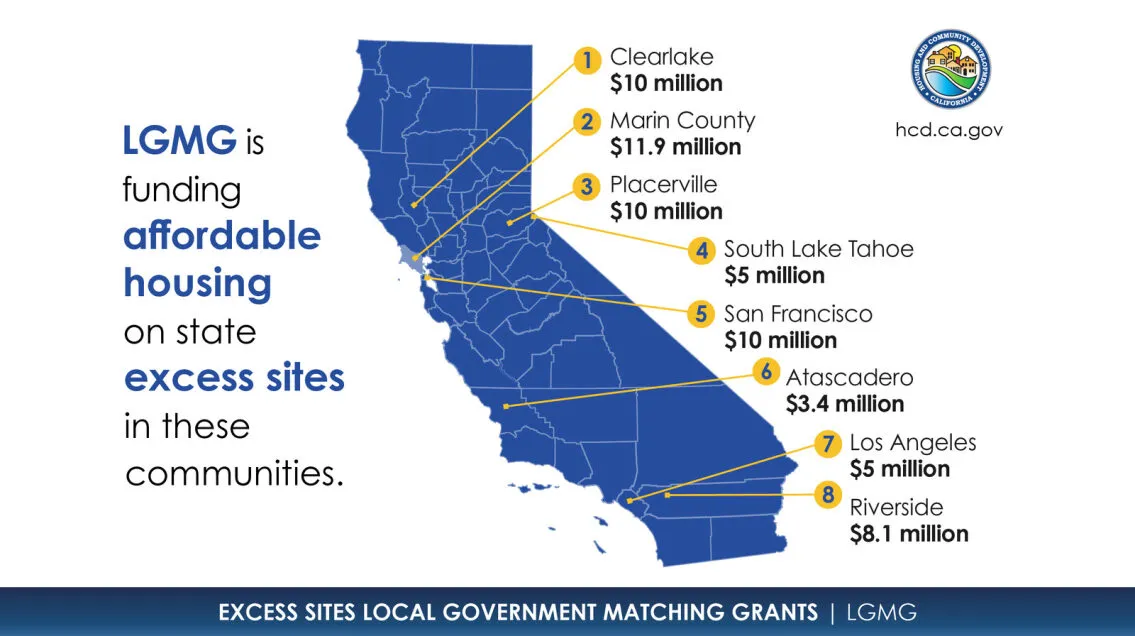
Today’s LGMG awards include:
- MidPen Housing Corporation received $10 million for the development of a 75-unit affordable housing project located in San Francisco. The project has received more than $20 million in local funding, including an Educator Housing loan from the San Francisco Mayor’s Office of Housing and Community Development. The project will be affordable to households earning between 30% and 120% of the Area Median Income (AMI) and have an occupancy preference for employees of the San Francisco Unified School District or San Francisco Community College District.
- Eden Housing, Inc. received $8.1 million to accelerate the development of Mulberry Gardens Family, a 150-unit affordable housing project in the City of Riverside. The project is bolstered by more than $10 million in local HOME funding and transportation fee waivers from the City of Riverside. The project aims to provide affordable housing to households earning between 30% and 60% AMI. Out of the 150 units, 76 will include two or three bedrooms. Mulberry Gardens Family is the first phase of a larger 209-unit community that will also include a senior housing project on the same site. The community will have an expansive open space with a children's play area, BBQ stations, picnic areas, and a community garden.
- Clearlake CIC, LP received $10 million for the development of Clearlake Apartments, an 80-unit affordable housing project in the city of Clearlake. The project has been awarded more than $3 million in federal CDBG - Disaster Recovery Multifamily Housing Program funding by the City of Clearlake through HCD. The project aims to develop 80 units that will be affordable to households with earnings between 30% and 60% AMI. Additionally, up to 20 units will be reserved for individuals or families with intellectual or developmental disabilities. The project also will include a community building, playground, and basketball half-court.
- Oak Hill Eden, LP received $1.9 million to construct Oak Hill Eden, which comprises 115 housing units. The project is situated in unincorporated Marin County and has received more than $6 million in local funding from various sources including locally allocated federal funds, the Permanent Local Housing Allocation program, the Marin County Housing Trust Fund, a Marin County Foundation Grant, and county fee waivers. The housing project will feature affordable units for households earning between 30% and 60% AMI. The project will feature a gym and a children's play area. This housing project is part of a larger initiative that aims to develop 250 units, including the Oak Hill Workforce Housing development.
- Education Housing Partners, Inc. received $10 million for the development of Oak Hill Workforce Housing, an affordable housing project comprising 135 units in unincorporated Marin County. The aim of this project is to provide affordable housing to educators who struggle to afford rent in the area. The homes will be available to households earning between 50% and 110% AMI. The project has received more than $21 million in local funding including MCPFA Series B Bonds, Marin County fee waivers, Marin County Housing Trust funds, and a Marin County Foundation Grant. All housing units will give preference to faculty and staff of schools under the Marin County Office of Education and employees of Marin County. Additionally, the project will include a community building, business center, fitness center, and bike parking.
- The Related Companies of California, LLC received nearly $2.1 million to build Alveare Family Housing, a new 105-unit multifamily development in the City of Los Angeles, out of which 60 units are for large families. The project aims to develop affordable homes for households earning between 30% and 60% AMI. This project is one of three phases of a larger 303-unit development, which will also include senior and permanent supportive housing (PSH) phases on the same site.
- The Related Companies of California, LLC received $2.9 million for the construction of Alveare Senior Housing, a new 100-unit senior development in the City of Los Angeles. The project aims to develop affordable homes for households earning between 30% and 60% AMI. The project, which will include a health clinic for residents, is one of the three phases of a larger development that will comprise 303 homes. The other phases will include family and PSH units on the same site.
- The Related Companies of California, LLC received $5 million for Sugar Pine Village Phase 2B, a 60-unit development in the City of South Lake Tahoe. This is the final phase of the Sugar Pine Village project, which will provide a total of 248 affordable homes for households earning between 30% and 80% AMI. The full community will include childcare facilities, green open spaces, and a community building with office space available.
- Jamboree Housing Corporation received $10 million for the development of The Clementine, an 83-unit housing project located in the City of Placerville. The project aims to provide affordable housing for households earning between 30% and 60% AMI. Furthermore, 48 of these units will be specifically designed to accommodate large families. The project will also feature a community kitchen, youth room, playground, and nature trail.
- People's Self-Help Housing Corporation received more than $3.4 million to build Paseo Paloma, a 72-unit multifamily development in the City of Atascadero. The project aims to develop affordable homes for households earning between 30% and 60% AMI. In addition to the housing units, the project will feature a tot lot and basketball court.
Please visit the HCD website for more information.
January 4, 2024
Pablo Espinoza
Off
HCD Press Office
Deputy Director of Communications
Article
Deadline Approaching for Homeowners Affected by Natural Disasters in 2017 and 2018 to Apply for Grants to Rebuild
Off
Sacramento, CA

Resources are still available to help California homeowners affected by the 2017 and 2018 wildfires and other natural disasters rebuild their homes. However, the deadline to apply for these funds is quickly approaching.
Many victims of natural disasters do not have enough funds to complete the repair or rebuild of their damaged homes, even with insurance claims and financial settlements. The California Department of Housing and Community Development’s (HCD) ReCoverCA Owner-Occupied Rehabilitation and Reconstruction Program helps provide recovery support to survivors of federally declared natural disasters. Eligible homeowners can receive grants of up to $500,000 to address unmet rehabilitation and reconstruction needs.
Homeowners affected by 2017 and 2018 wildfires, mudflow, and debris flows have until December 31, 2023, to complete the first required step of the process – submitting the Disaster Housing Needs Assistance survey available on the ReCoverCA website. Once submitted, eligible homeowners will be contacted by a case manager and invited to submit a full application. The deadline to submit the completed application is January 31, 2024.
Eligible applicants must have owned and occupied a single-family or manufactured home affected by a 2017 or 2018 federally declared natural disaster in the following counties: Butte, Lake, Los Angeles, Mendocino, Napa, Nevada, Orange, San Diego, Santa Barbara, Shasta, Sonoma, Ventura, and Yuba. Eligibility has been recently expanded to include applicants making up 120% of the area median income, with priority going to lower-income households.
ReCoverCA funds are meant to help repair or reconstruct primary residences after all other funding, including insurance and settlements, is exhausted. To date, the ReCoverCA program has issued 99 grant awards totaling $32 million to help rebuild homes.
Homeowners are encouraged to complete the survey, even if they are unsure if they are eligible for ReCoverCA funds. Interested applicants can find valuable resources and program information in English and Spanish on the ReCoverCA website.
Homeowners affected by the 2020 wildfires also can now apply for ReCoverCA funds. Please visit the ReCoverCA website for more information.
December 4, 2023
ReCoverCA awards of up to $500,000 help address unmet construction needs
Pablo Espinoza
Off
HCD Press Office
Deputy Director of Communications
Article
Homekey Funds Another 613 Homes for Californians at Risk for Homelessness, as Governor’s Investment in Round 3 Grows to $850 Million
Off
Sacramento, CA
Governor Gavin Newsom today announced more grant awards from the $850 million Round 3 of Homekey, the Administration’s initiative to help communities to address the challenge of homelessness by rapidly expanding the availability of housing for at-risk individuals and families
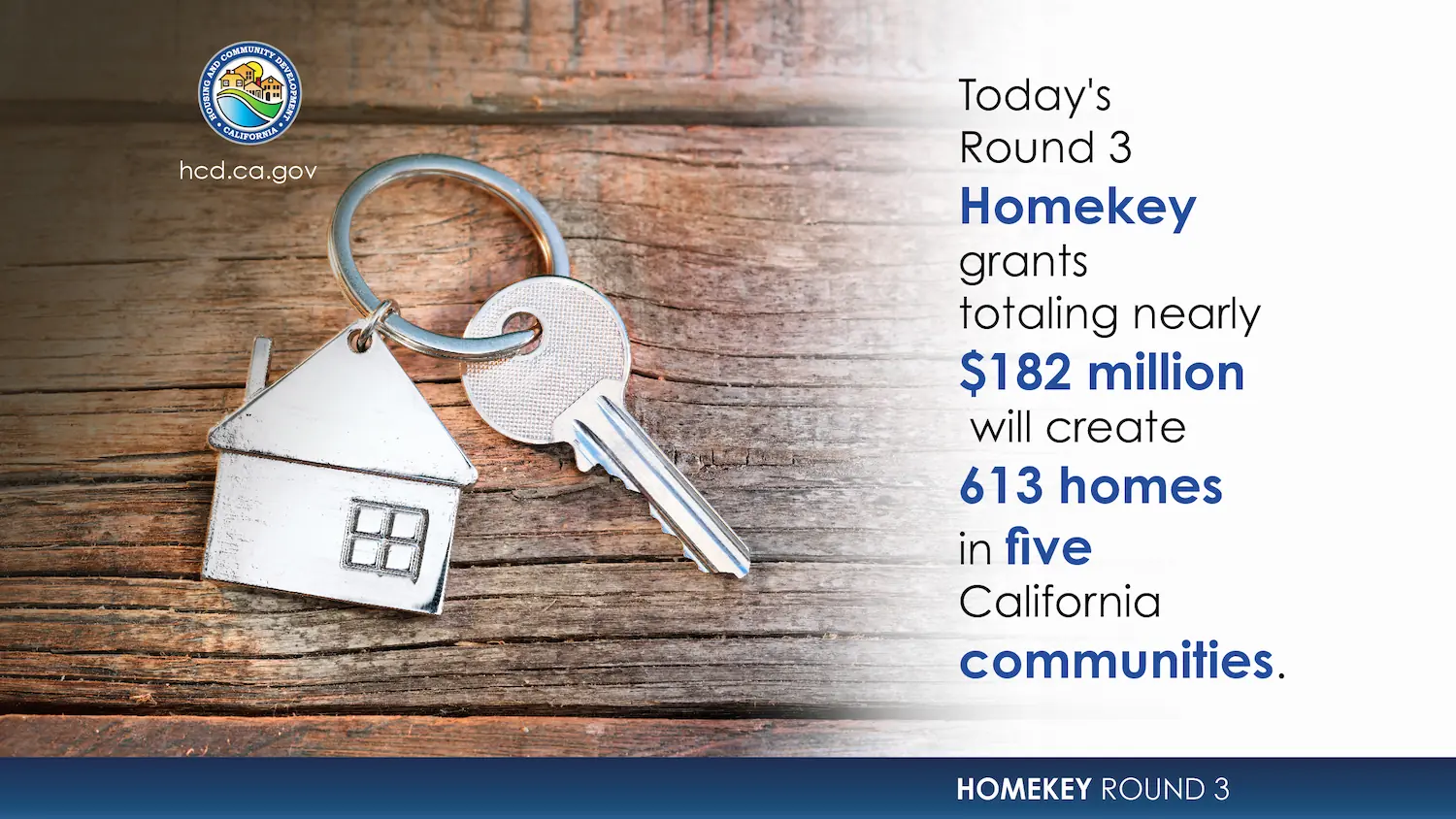
Today’s $182 million in Homekey awards will fund nine projects in five California communities, funding 613 new affordable homes with more than a third of those units reserved for people experiencing chronic homelessness. This batch of awards funds 516 homes in Los Angeles County. Through the first three sets of Round 3 awards approved by the California Department of Housing and Community Development (HCD) this fall, 1,878 homes have been funded, bringing the total of homes funded across three rounds of Homekey to 14,652.
“Homekey continues to be one of California’s most successful efforts to rapidly create housing for people struggling with homelessness,” said Governor Newsom. “Through this innovative approach, we have funded over 14,600 homes in communities all across the state.”
Originally launched months into the COVID-19 pandemic as an extension of Project Roomkey – to curb the spread of disease among Californians in congregate shelters – Homekey funds additional building types and supports a broader population of people experiencing or at risk for homelessness. This includes young people transitioning to adulthood from foster care or an unsafe environment.
“Homekey continues to serve as a model for communities across the nation confronting the crisis of homelessness,” said HCD Director Gustavo Velasquez. “Born out of necessity in a time of crisis, Homekey has evolved our thinking of how to most effectively and quickly create quality housing to support Californians in a life lived off the streets and connected to critical services that help ensure lasting stability.”

Homekey Round 3 grant funding – administered by HCD – is available to local public entities including cities, counties, tribes, and housing authorities to develop a broad range of housing types including hotels, motels, hostels, single-family homes, multifamily apartments, adult residential facilities, and modular housing, and to convert commercial properties and other existing buildings to permanent or interim housing.
On November 15, HCD amended the Homekey Round 3 NOFA to add $114 million in supplemental funding to the initial pool of $736 million, providing the opportunity to fund additional eligible applicants. With approximately $513 million remaining, HCD continues reviewing applications, and grants will be announced on a rolling basis until all funds are exhausted.
- The City of Berkeley, in partnership with Housing Consortium of the East Bay and Memar Properties, Inc. (dba MPI Homes), will receive $14,128,813 in Homekey Round 3 funding for the University Inn (formerly Rodeway Inn) project, an acquisition and rehabilitation project that will convert an existing motel to create 42 studio units serving people who are homeless or chronically homeless.
- Contra Costa County Health Services will receive $16,000,000 for the 2555 El Portal project, to acquire a remodeled office complex that will create 54 studio units to serve 54 individuals experiencing chronic homelessness. The organization’s Health Housing Homeless Services division will provide supportive services.
- The City of Los Angeles will receive $26,579,000 for The Weingart Shelby project, to acquire and rehabilitate an existing 78-unit assisted living facility to create 78 units of interim supportive housing for individuals experiencing chronic homelessness.
- The Housing Authority of the City of Los Angeles will receive $18,225,000 for the 4065 Oakwood project, to acquire and rehabilitate a newly built market-rate apartment complex that will create two studio, 25 one-bedroom, and 41 two-bedroom units to serve people and families who are homeless or at risk for homelessness. The County of Los Angeles Department of Health and Services will fund People Assisting the Homeless (PATH) to provide supportive services.
- The Housing Authority of the City of Los Angeles will receive $9,375,000 for the 4818 N Sepulveda Blvd project, to acquire a newly constructed multifamily property. The project will provide permanent supportive housing for 34 households with incomes at or below 30% AMI, with half of units dedicated to people experiencing homelessness and half of units for those at risk of homelessness. PATH will provide supportive services.
- The Housing Authority of the City of Los Angeles will receive $7,000,000 for the 3705 McLaughlin project, to acquire a newly built apartment building and five newly constructed accessory dwelling units that will create 25 permanent homes serving households that are experiencing or at risk for homelessness.
- The County of Los Angeles, in partnership with Hope the Mission, will receive $27,659,747 for the Lancaster Pathway Home project. The acquisition and rehabilitation project will convert an existing hotel and create 102 studio housing units to serve households experiencing homelessness and chronically homelessness.
- The County of Los Angeles, Weingart Center Association, and Valued Housing II, LLC will receive $34,356,700 for The Weingart Primrose project, to acquire and rehabilitate a hotel that will create 106 studio units to serve 53 chronically homeless and 53 at-risk of homeless households. Off-site amenities, located within one mile of the project include transportation stops, a medical clinic, book-lending public library, pharmacy, and public park. Weingart Center Association will provide wrap-around supportive services.
- The County of Los Angeles, in partnership with Hope the Mission, will receive $28,662,113 for the Knight's Inn Palmdale project, an acquisition and rehabilitation project that will convert an existing motel to create 100 permanent housing units serving people experiencing homelessness.
Please visit HCD’s website for a full list of Homekey awards.
December 4, 2023
Today’s Awards Will Create 516 Homes in LA County, Bringing Total of Homes Funded to 14,652
Pablo Espinoza
Off
HCD Press Office
Deputy Director of Communications
Article
California Awards $126 Million from CalHome to Increase Homeownership and Revitalize Homes and Neighborhoods
Off
Sacramento, CA

The Department of Housing and Community Development (HCD) today announced more than $126 million in funding aimed at increasing opportunities for homeownership, encouraging neighborhood revitalization and sustainable development, and maximizing use of existing homes in 23 California counties.
Today’s 38 awards from the CalHome program will fund projects that support homeownership programs aimed at low- and very low-income households and are operated by local government agencies, tribes, and nonprofit organizations.
“Becoming a homeowner is one of the surest ways to gain housing security and build generational wealth,” said HCD Director Gustavo Velasquez. “CalHome presents a tremendous opportunity to make homeownership possible for people who never thought it would be attainable, strengthening both families and communities.”
In January, HCD announced the first-ever Homeownership Super Notice of Funding Availability (HOSN) for approximately $170 million, including $135 million in funds for the following CalHome Program and $35 million for the Joe Serna, Jr. Farmworker Housing Grant Program – Homeownership.
CalHome provides grants and loans for first-time homebuyer mortgage assistance programs, owner-occupied rehabilitation programs, homeownership development projects, self-help technical assistance projects, and accessory dwelling unit (ADU)/junior ADU programs. Awards are made to local government agencies, tribes, and nonprofit organizations, who then assist individuals in their community.

Today’s 38 CalHome awards will fund projects assisting 1,300 households in the counties of Alameda, Butte, Calaveras, Contra Costa, Fresno, Glenn, Humboldt, Kern, Kings, Lake, Los Angeles, Madera, Marin, Merced, Nevada, Riverside, Sacramento, San Bernardino, San Mateo, Santa Clara, Santa Cruz, Tulare, and Yuba.
Please visit HCD’s website for a full list of CalHome awards.
December 1, 2023
Pablo Espinoza
Off
HCD Press Office
Deputy Director of Communications
Article
Top